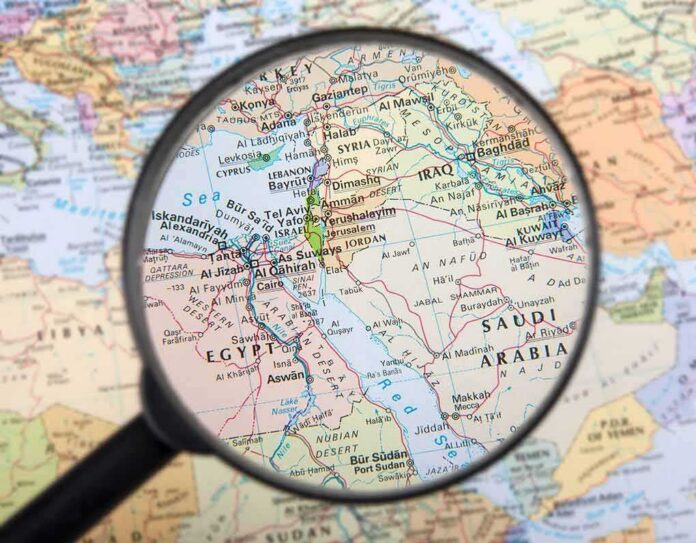
Iran’s Revolutionary Guard says it fired ballistic missiles and drones at two American military bases in Jordan, the latest strike in a war that has dragged on for six months.
Quick Take
- Iran’s Islamic Revolutionary Guard Corps claims it hit the King Hussein and Al Azraq bases in Jordan with missiles and drones.
- Jordan’s military intercepted most of the incoming fire, limiting damage on the ground.
- Iran says the strike answered a U.S. attack on Larak Island, an Iranian military site.
- President Trump warned Iran will “pay the price” for dragging out the fight instead of striking a deal.
- This marks one of several Iranian strikes on Jordan since June, as the broader U.S.-Iran conflict grinds on.
Iran Claims Missile Strike on U.S. Bases in Jordan
Iran’s Revolutionary Guard said Monday it launched ballistic missiles at the King Hussein and Al Azraq bases in Jordan, where U.S. forces operate. Iranian state media called the strike a direct response to a U.S. attack on Larak Island, an Iranian military site in the Strait of Hormuz. Tehran’s forces used a mix of drones and missiles in what officials labeled a “necessary and lawful answer” to American action.
Jordan’s military said its air defenses knocked down most of the incoming missiles before they could do real damage. The kingdom has repeatedly found itself caught between Washington and Tehran simply because it hosts American troops. Jordan has publicly emphasized its own air defense success rather than picking a side, a pattern that has held through each of Iran’s strikes this year.
A Pattern Stretching Back to June
This is not an isolated event. Iran has struck Jordan multiple times since June, hitting the same bases with waves of ballistic missiles as the wider war with the United States has ground on for six months. Iranian forces have also launched drones and missiles at American assets in the United Arab Emirates during the same period, spreading the fight across the region.
Analysts tracking the conflict say Iran appears to be testing how far it can push before Washington escalates further. Iran’s July 28 strike on the Muwaffaq al-Salti Air Base near Azraq, using five ballistic missiles, was described by defense researchers as an attempt to probe the limits of U.S. patience rather than a one-time act of retaliation.
Trump Vows Iran Will Pay the Price
President Trump did not mince words after Iran claimed responsibility for coordinated attacks on U.S. forces in Bahrain, Kuwait, and Jordan. He said Iran will “pay the price” for taking too long to negotiate, a clear signal that his administration has no patience left for Tehran’s stalling tactics after months of failed diplomacy.
That response tracks with a broader shift away from the appeasement-style diplomacy conservatives have criticized for years. Rather than absorb attacks quietly, the administration has answered Iranian aggression with direct strikes on Iranian territory, including the hit on Larak Island that triggered this latest round of missile fire on Jordan.
American Troops Have Paid a Price Too
The war has already cost American lives. U.S. Central Command said it retaliated after what it called an “attempted surprise attack” by Iran, and the Pentagon has confirmed troop deaths tied to earlier Iranian missile strikes near Jordan. Every escalation raises the stakes for the roughly 3,000 U.S. troops still stationed in the kingdom.
Jordan’s cooperation with American forces has made it a repeated target, even though the kingdom has no direct role in the fight between Washington and Tehran. Its air defenses have intercepted dozens of missiles over the past six months, a track record that has kept casualties low but has not stopped Iran from trying again. The kingdom’s willingness to keep hosting U.S. bases despite the risk shows the strength of that alliance under pressure.
For conservatives who have long argued that weakness invites aggression, this conflict underscores the point. Iran escalated only after testing American resolve, and it has kept attacking as long as it believed Washington might blink. A firm response, backed by allied air defenses like Jordan’s, remains the clearest deterrent against a regime that has shown no interest in backing down on its own.
Sources:
military.com, cnn.com, fdd.org, euronews.com, latimes.com, cbsnews.com