

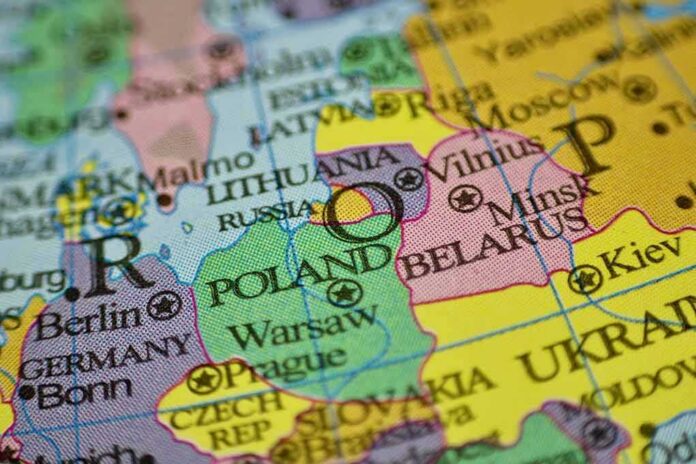
Poland says Russian missiles and a drone crossed into its territory during a massive strike on Ukraine, putting NATO’s red line to the test.
Story Highlights
- Poland reported three airspace violations amid a large Russian attack on Ukraine.
- Polish officials identified one object as a Russian Kh-101 cruise missile.
- Prime Minister Donald Tusk called the incident an “intentional provocation”.
- Poland tracked 11 nearby objects and requested added NATO support.
Poland Reports Three Russian Objects Entered Its Airspace
Polish authorities said three objects entered Poland during a large Russian missile and drone assault on Ukraine on November 20, 2026. Defence Minister Władysław Kosiniak-Kamysz said debris was found at three sites: Nowy Lipowiec, Rudnik nad Sanem, and Mołodycz. He said one object was a Kh-101 cruise missile, the second was likely a missile, and the third was likely a jet-powered drone. Officials reported no injuries and no critical infrastructure damage.
Operational Commander General Ireneusz Nowak said Polish air-defense forces tracked 11 aerial objects near the border and assessed that three crossed into Polish territory. The defense minister stated, “There has been a violation of Polish airspace and an incursion by objects from the Russian Federation.” Investigators secured the crash sites, and military prosecutors opened formal inquiries. Authorities emphasized public safety and urged residents to avoid debris until teams finished sweeps.
Warsaw Labels The Breach A Provocation And Engages NATO
Prime Minister Donald Tusk convened an emergency meeting with military commanders and security officials. He said the events appeared to be an “intentional provocation” and that there was no doubt the objects were Russian. In response, Poland called for added North Atlantic Treaty Organization support and coordination. Allied jets scrambled to monitor the border area as the situation developed. The government framed the incident as a serious national-security matter requiring rapid action.
Reuters and other outlets reported the violations occurred as Russia launched a large wave of missiles and drones at targets inside Ukraine. That context matches a pattern seen since 2022, when Russian weapons and aircraft have approached or sometimes entered alliance airspace during major strikes. Analysts note that these events stress NATO readiness and test air defenses along the eastern flank, where Poland plays a front-line role in deterrence.
Identification, Evidence, And Ongoing Inquiries
Polish officials identified one recovered object as a Russian Kh-101 missile. They described the second as probably a missile and the third as most likely a jet-powered drone. Public reporting to date has not included the full radar tracks, fragment analysis, or launch data that investigators typically hold back during active probes. Authorities said work continues to verify exact flight paths, component origins, and whether the route into Poland was programmed or the result of diversion.
Tusk’s “intentional provocation” assessment came as investigators continued their technical review. Officials used careful terms such as “probably” or “most likely” for two of the three objects, reflecting standard caution until labs and prosecutors complete their reports. Even so, Warsaw’s public line is clear: Russia’s weapons crossed a NATO border, and the alliance must respond with unity and resolve to prevent escalation and defend its members’ territory.
What This Means For NATO And The United States
This breach matters because Poland is a North Atlantic Treaty Organization member, and any attack on its territory could trigger alliance consultations. Poland’s request for more NATO forces underlines the stakes. A North Atlantic Treaty Organization policy analysis notes that it is often hard to separate deliberate provocations from navigation failures or technical breakdowns, but the strategic risk is the same: pressure on the alliance’s credibility and response timelines.
For American readers, one thing is plain: borders and airspace sovereignty must be respected. President Trump has prioritized strong defense, fair burden sharing, and energy policies that reduce leverage for hostile regimes. This incident shows why deterrence, missile defense, and tight logistics matter. Clear lines, clear consequences, and support for allies like Poland help prevent wider war. Congress should back layered air defenses and rapid resupply so our forces and partners can end threats before they hit home.
Sources:
redstate.com, reuters.com, kansas.com, politico.com, independent.co.uk, hromadske.ua, english.nv.ua