
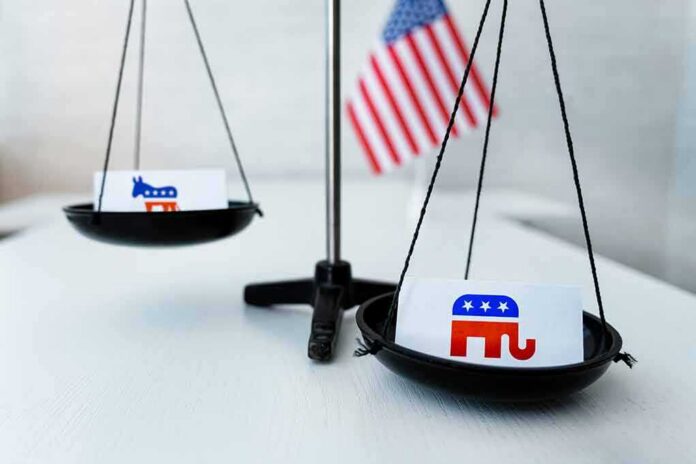
The Supreme Court’s June 30 ruling freed political parties to fully coordinate spending with candidates, giving Republicans a lawful organizing edge heading into the 2026 midterms.
Story Highlights
- The Court struck down federal limits on party-candidate coordinated spending, expanding First Amendment protections for campaigns.
- Missouri court decisions kept GOP-friendly maps in play for much of 2026, with coverage calling the result a Republican boost.
- Democratic groups condemned the finance ruling but also said they could adapt over time.
- Legal fights and ballot measures in Missouri created timing risks, but Republicans still gained room to maneuver.
What Changed: Parties Can Now Coordinate Spending With Candidates
On June 30, the Supreme Court ruled 6-3 that federal limits on coordinated spending between party committees and candidates violate the First Amendment. Reuters reported that the Court “strikes down curbs on coordinated campaign spending,” ending a long‑standing cap that restricted how much a party could plan and spend with its nominees. ABC News said the decision rolled back limits that had blocked full coordination, opening the door for stronger, clearer teamwork in races nationwide.
The ruling means national and state party committees can now directly align strategy, media, and field work with their candidates without hitting a federal dollar ceiling. That helps campaigns waste less and focus on winnable voters. It also rewards disciplined planning over outside-group noise. For conservatives who value free speech and fair competition, the Court’s message was simple: political parties and their nominees can speak and plan together without government caps getting in the way.
How Missouri’s Map Fights Tilted the Field for 2026
Missouri’s redistricting saga kept Republicans competitive by preserving maps favorable to the party for most of the cycle. In March, the Missouri Supreme Court allowed a Republican-drawn congressional map to stand, citing the legislature’s power to revise districts more than once a decade. That ruling signaled GOP momentum and kept a party-friendly structure in place for key seats during the run-up to fall campaigns. Coverage widely described the outcome as a Republican win expected to aid the party.
Later rulings added twists. The court sent a newer map to voters and affirmed that it would not take effect without approval, complicating late changes. Reporting indicated the 2022 districts would remain the operative lines for November 2026, curbing a push for a different layout this close to Election Day. A September account described the court tossing the new map weeks before voting, underscoring that legal timing still matters even when broader trends favor the GOP.
Why This Favors Republicans Now — And What Could Blunt It
Republicans gain most when parties can coordinate with nominees and when maps are settled early. The finance ruling lets the Republican National Committee and congressional committees sync spending with conservative candidates to stretch every dollar. That is vital in House battlegrounds where small shifts decide outcomes. Analysts said the Court’s move could erase Democrats’ cash edge in Senate races, putting Republicans on stronger footing where resource parity matters.
Democrats pushed back hard. Lawyers for Democratic groups told Reuters they “strongly disagree,” saying the Court upended precedent and weakened a key pillar of campaign finance law. Yet Democrats also signaled they would adjust. ABC News quoted a strategist saying the new rules could help their committees because funds can “go farther” when coordinated. That shows the rule change is real, while the advantage will depend on who organizes better in the short window to November.
Bottom Line for Conservative Voters
The Court expanded free speech for political parties and candidates, which fits core constitutional values. The Missouri rulings, despite late turbulence, left Republicans competing on favorable or familiar ground for 2026. Together, these shifts give conservatives a cleaner path to align messages, reduce waste, and fight back against big-spend liberal machines. The payoff will hinge on execution: recruiting volunteers, targeting swing voters, and keeping spending tight and effective inside the law.
Two cautions remain. First, Missouri’s court actions show that lawsuits and ballot steps can still change timelines and maps near Election Day, creating confusion that hurts turnout if campaigns are not ready. Second, media framing can inflate or deflate expectations. Some outlets called the Missouri decisions a “major win,” but votes still decide wins, not headlines. The task now is simple: use the freedom to coordinate, focus messages on border security, safe streets, and lower costs, and finish strong.
Sources:
townhall.com, nbcnews.com, molawyersmedia.com, abcnews.com, kcur.org, thehill.com, reuters.com, cfr.org