

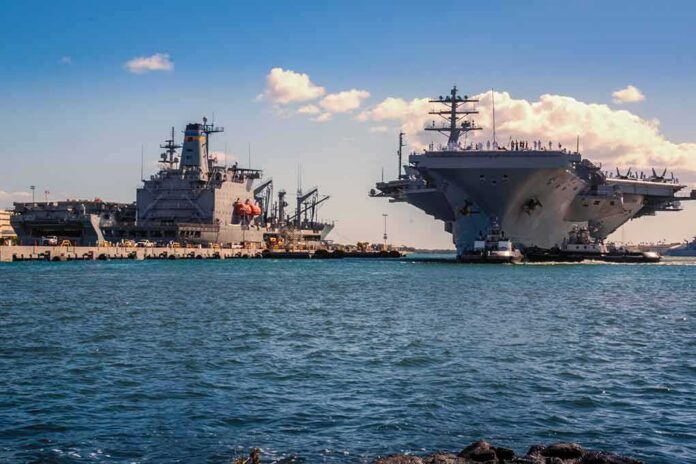
The Navy evacuated roughly 1,300 to 1,500 family members from Bahrain after Iranian attacks, and many still have no clear path home.
Story Highlights
- The Navy moved about 1,300–1,500 dependents and others out of Bahrain after attacks.
- Navy leaders told families they expected a short war and planned around that.
- Months later, officials say families cannot return and should resettle elsewhere.
- Families report major costs and stress during long displacement without a firm plan.
Evacuation Scale Shows How Serious The Threat Became
Reporters at National Public Radio said a Navy spokesman confirmed that about 1,500 sailors, family members, and several hundred pets were relocated from Naval Support Activity Bahrain in early April 2026. CBS later reported about 1,450 evacuees. These figures show the danger was real and immediate. The decision moved beyond routine caution and into large-scale family protection. This was not a drill or a brief base pause. It was a rapid drawdown under combat risk.
Navy documents shared through media accounts place the evacuation start on March 2. The size and speed of the move show planners faced a growing threat. The transfer uprooted households and split service members from spouses and kids. That choice reflects the seriousness of the strikes and the mission to keep noncombatants safe. The scale also set off months of housing, travel, and school impacts that ripple through every family budget and routine.
Leaders Admitted They Expected A Short Conflict
Vice Admiral Curt Renshaw, who leads Fifth Fleet, told families the Navy thought the war would be short. He said leaders delayed tough calls because they hoped to reopen Bahrain to families. He also said the Navy was “making it up as we go,” since few systems were built for a long conflict. That explains early optimism, but it also shows why many families landed in limbo as weeks turned into months without a full return plan.
Stars and Stripes reported that nearly six months after the evacuation, officials said families could not return “for the foreseeable future” and should find new homes. That message shows the pivot from short-term disruption to a medium- or long-term reset. It also signals that planners judged the threat and local conditions still too unstable for dependents. For families, that means new leases, new schools, and new costs far from their original duty station.
Families Face Lingering Costs While Rules Cap Support Timelines
National Public Radio reported that authorized and ordered departures cannot run past 180 days. That federal limit shapes how the State Department and the Navy manage benefits and timelines. When a crisis runs longer, agencies must either extend under a new order or shift families to different support tracks. During that gap, real people juggle hotel bills, storage fees, and childcare changes as official guidance evolves alongside the threat.
Stars and Stripes described evacuees facing hotel hopping, rental cars, and mental health strain. Some families reported major out-of-pocket costs while they waited for clearer next steps. These are not abstract program lines. They are bills due at the end of the month. The longer the uncertainty, the harder it is on morale and readiness. When family life is upended, the sailor’s focus and the fleet’s edge can suffer in turn.
Navy Messaging Shifts From Reassurance To Resettlement
CBS quoted a Navy spokesperson saying the service was providing timely information, case managers, and relocation support. That support matters. But families also heard new guidance: pick a more permanent location while the military decides Bahrain’s future. That shift acknowledges reality. The mission continues in a hot theater, but dependents will not be back soon. Clearer orders and faster reimbursements would reduce stress and protect force readiness.
The civilian head of the Navy has confirmed that a key U.S. Navy base in the Middle East was damaged in recent fighting in the Iran war, according to a new report.
“They blew the hell out of Bahrain,” acting Navy Secretary Hung Cao told The Epoch Times on Sept. 9, referring to…
— Parallel Polis in Exile 🇺🇸 (@Polis_in_Exile) September 15, 2026
Admiral Karl Thomas told National Public Radio the Navy had not released an overall plan and reopening to families seemed unlikely in the near term. That candor helps, but families still need predictable timelines and funding rules that match a conflict that lasts. The goal now should be simple: finish the move to stable, safe housing, pay what the rules allow fast, and publish a timeline with clear decision points so parents can plan schools, jobs, and care without guesswork.
Sources:
crbcnews.com, cbsnews.com, npr.org, stripes.com