
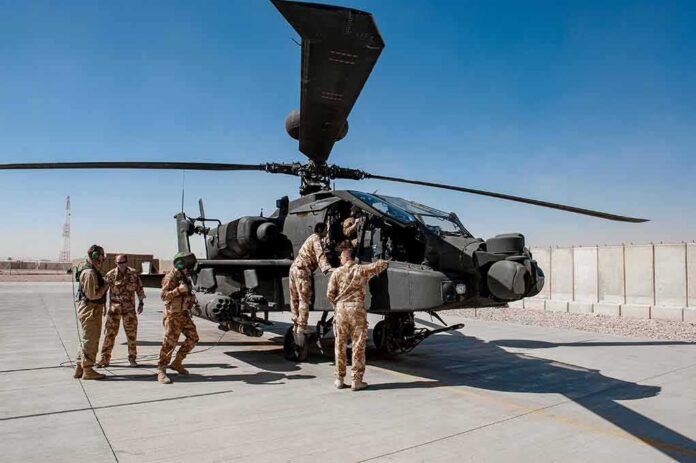
As Iran blames “accidents” and calls for restraint, U.S. forces strike back after an Army Apache goes down.
Story Snapshot
- U.S. Central Command launched strikes in Iran after a U.S. Army Apache helicopter was downed [2].
- The Pentagon framed the action as self-defense and a measured response to protect U.S. troops [2][7].
- Iranian voices and some legal experts dispute the self-defense claim and urge restraint [8][11][19].
- The clash fits a long pattern of fast military moves followed by legal debates over necessity and proportionality [15].
U.S. Response Tied to Downed Apache and Troop Safety
U.S. Central Command said forces began self-defense strikes after a U.S. Army Apache helicopter was downed near the Strait of Hormuz. Bloomberg reported that operations started around 5 p.m. Eastern Time, hours after President Donald Trump vowed to respond [2]. Public statements stressed protection of American personnel and a limited scope. Public Broadcasting Service reporting echoed that message, noting the military said it aimed to protect troops from Iranian threats while showing restraint [7].
Officials pointed to clear triggers and targets to justify the use of force. The administration has also prepared options for follow-on strikes if needed, even as diplomatic channels remain active [1]. That planning reflects a two-track approach: keep force ready to deter further attacks, while using talks to lower risk. In this moment, the core claim is simple and direct: Iran caused an American loss, and the United States acted to stop more harm [2][7].
Competing Claims: Tehran Denial and Legal Pushback
Iranian officials and sympathetic commentators dispute the self-defense case. Foreign Policy reported that Tehran called the strikes unjustified and labeled them aggression [8]. A legal expert at the University of Reading argued the United States cannot rely on self-defense in this instance, questioning both necessity and evidence of an imminent threat [11]. Just Security analysts also challenged anticipatory self-defense claims, warning the legal bar is high and facts must meet strict tests [19].
These counter-claims try to slow the momentum of U.S. action by shifting the debate to process and proof. They echo a well-known pattern in U.S.–Iran crises. Lawfare explains that when the United States targets Iranian forces on self-defense grounds, there is usually a concrete link to an attack, and debate then turns on proportionality and timing [15]. The current case follows that track: a downed aircraft, a limited U.S. strike, and rapid legal challenges in the press [2][7][15].
Pattern of Crisis: Fast Strikes, Then Law and Diplomacy
The broader context is an intense year of conflict where U.S. and Israeli strikes hit Iranian military sites at scale early in the war. Encyclopaedia Britannica reported that on February 28, 2026, nearly 900 strikes hit Iranian missiles, air defenses, and other military targets within 12 hours [3]. That backdrop explains why each new incident triggers fast responses and quick legal fights. Governments move first to blunt threats, and lawyers argue about rules while the dust settles [3][15].
For conservatives, the core test is simpler than the legal maze. Did Iran or Iranian forces cause American harm, and are U.S. troops safer after the strike? Central Command links action directly to the Apache loss and to protection of forces in the region [2][7]. That aligns with the duty to defend American lives and avoid a wider war. It also rejects the idea that “restraint” means turning the other cheek when our aircraft go down [2][7].
What This Means for Deterrence, Energy, and U.S. Resolve
Deterrence needs clarity. Clear triggers and quick, proportional hits tell Tehran there is a cost for striking Americans. Careful target choices and open channels also lower the chance of a spiral. CBS News reporting shows the administration kept military options ready while diplomacy continued, which supports pressure without blank checks [1]. This balance protects U.S. troops, backs allies, and keeps global markets steadier by pushing threats away from major sea lanes [1][2][7].
Iran-US tit-for-tat strikes
The characterization of the latest tit-for-tat strikes between Iran and the United States is interesting. Both Washington and Tehran have described their respective actions as acts of "self-defense."
This is important because it indicates a…
— Kamran Yousaf (@Kamran_Yousaf) June 10, 2026
Readers should watch three things next. First, evidence on the Apache incident, which can firm up the case for self-defense. Second, Iranian behavior at sea and in the air, which tests if deterrence holds. Third, talk of “restraint” from foreign capitals that never face our risks. America’s job is to defend Americans. The administration says that is what these strikes did. The facts so far support that narrow mission while keeping the door open to end the fight on better terms [2][7][15].
Sources:
[1] Web – US Strikes Iran After Blaming Tehran for Helicopter Crash. Iran Fires …
[2] Web – U.S. prepares for new military strikes against Iran
[3] Web – US Launches Strikes Against Iran After Helicopter Shot Down
[7] YouTube – U.S. military launches new strikes on Iranian drones
[8] Web – U.S. says it carried out ‘self-defense’ strikes in Iran, including …
[11] YouTube – U.S. launches ‘self-defense strikes’ against Iran after …
[15] Web – Israel and America’s Legal Case for Self-Defense – The Blogs
[19] YouTube – US military says it carried out ‘self-defense’ strikes in Iran …