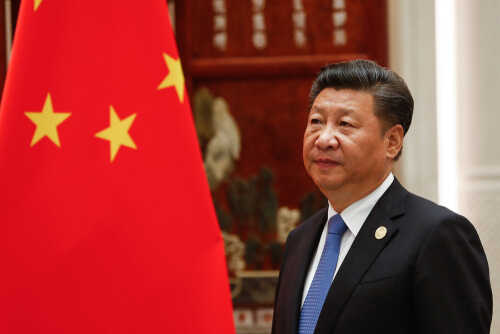
China’s refusal to participate in Russian-led security guarantees for Ukraine reinforces NATO’s central role and undercuts Moscow’s efforts to diversify support.
At a Glance
- China ruled out sending troops or joining security guarantees for Ukraine on August 25, 2025.
- Russia’s proposal to involve China stalled after Beijing’s rejection.
- Ukraine continues relying on U.S. and NATO commitments for defense.
- China’s neutrality limits its influence in European security matters.
- Western leaders dismiss Russia’s multilateral push as diplomatic posturing.
China Shuts the Door
On August 25, 2025, China’s Foreign Ministry spokesman Lin Jian stated that Beijing would not send troops or join peacekeeping missions in Ukraine. The announcement rejected both Russian and Western suggestions that China play a direct role in guaranteeing Ukraine’s security. This position reflects Beijing’s longstanding reluctance to become militarily entangled in foreign conflicts.
Watch now: China Rejects Ukraine Role · YouTube
The decision followed recent diplomatic exchanges, including an August 18 meeting between Ukrainian President Volodymyr Zelensky and U.S. President Donald Trump in Washington. Their talks highlighted Western military backing as Ukraine’s primary lifeline. Just days later, Russian Foreign Minister Sergey Lavrov floated a proposal to bring China and other United Nations Security Council members into a multilateral security framework. With China’s rejection, that effort has collapsed, leaving Russia without the global backing it sought.
Diplomatic Gambits and Strategic Priorities
Russia has consistently pursued alternatives to Western-dominated arrangements since its 2022 invasion of Ukraine, hoping to dilute U.S. influence by invoking broader international involvement. Moscow’s attempt to bring China into the equation represented its latest effort to shift the balance of power. However, China’s decision to stay out reinforces the reality that U.S. and NATO guarantees remain the cornerstone of European security.
China’s neutrality reflects broader strategic priorities. Beijing aims to preserve diplomatic flexibility, avoid risky entanglements, and maintain balanced relations with both Russia and the West. Historically, China has participated in military operations only under carefully managed UN peacekeeping missions. By steering clear of Ukraine, Beijing protects its sovereignty while avoiding precedents that could complicate its own security environment.
U.S. and NATO’s Central Role
The refusal leaves Ukraine with limited options beyond continued reliance on Western military support. Zelensky’s engagement with Washington and NATO demonstrates Kyiv’s strategic alignment with institutions capable of providing real deterrence against further Russian aggression. For the United States, this outcome reaffirms its leadership role in European stability. NATO remains the institution best positioned to provide enforceable security guarantees.
Analysts note that while Russia and China maintain a strategic partnership, their interests diverge sharply over Ukraine. China’s reluctance to join Russian-led schemes undercuts Moscow’s diplomatic leverage. This further isolates Russia, whose efforts to create alternative security structures without Western participation have failed to gain traction.
Long-Term Impact
The immediate consequence of Beijing’s rejection is the collapse of Russia’s proposed multilateral framework. For Ukraine, this underscores dependence on bilateral and NATO-based commitments. In the longer term, China’s choice preserves its nonaligned posture but diminishes its influence in Europe’s evolving security order. Meanwhile, Western leaders view the rejection as proof that Moscow’s globalist security visions lack credibility.
Experts argue that effective deterrence and stability will continue to depend on American-led initiatives. NATO membership and bilateral agreements remain Ukraine’s strongest guarantees, while multilateral alternatives are dismissed as impractical. In rejecting participation, China has unintentionally reaffirmed U.S. dominance in European security—showing that global power still rests with alliances capable of decisive action rather than aspirational frameworks.
Sources
Fox News
Tasnim News
Just Security
Hudson Institute