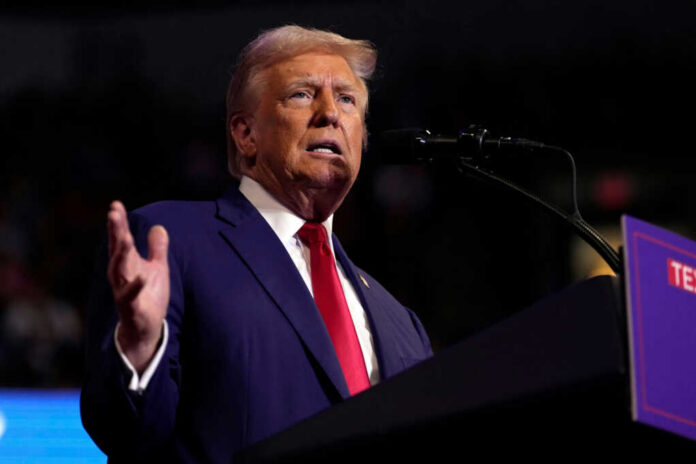
Trump warns that Maryland Governor Wes Moore’s rhetoric and actions risk undermining the military while crime and governance disputes intensify.
Story Snapshot
- Trump and Moore escalate a public feud spanning crime, immigration, and federal intervention [1].
- Moore labeled some Trump-related military orders “unlawful,” invoking rules on disobeying illegal commands [5].
- Moore positions himself as a veteran and Maryland National Guard leader while criticizing Trump’s approach [5].
- Available records show a broader dispute over policy and deployment, not explicit attacks on the Air Force itself [4].
Documented Feud Between Trump and Moore Sets the Stage
CBS News Baltimore reported that President Donald Trump and Maryland Governor Wes Moore have traded barbs across multiple fronts, including immigration and even a Potomac River sewage incident, creating a prolonged environment of public confrontation [1]. That backdrop matters because it shapes how each statement is interpreted by voters. When disagreements span crime policy, border issues, and federal aid, subsequent clashes about military authority and deployment get folded into a single, high-stakes narrative about competence, safety, and constitutional limits [1].
As the feud intensified, Trump publicly criticized Moore’s record and responses, including Moore’s reactions to federal involvement in local matters [1]. In turn, Moore addressed Trump’s broadsides in broadcast interviews, defending his leadership while pushing back on Trump’s characterizations of Maryland’s crime and public safety challenges [4]. This running dispute gives Trump a political basis to claim Moore’s comments about orders and deployments are part of a wider attack on his administration’s handling of military and security-related issues [1][4].
Moore’s Framing: Unlawful Orders and Military Obedience Rules
In a primary-source interview, Moore argued that service members are not required to follow unlawful orders, casting his critique as a constitutional and legal one rather than hostility toward the military [5]. He described certain Trump-related directives as “unlawful,” presenting his position through the military’s own duty to refuse illegal commands [5]. Moore also emphasized his background as a veteran and commander in chief of the Maryland National Guard, asserting respect for service members and their families even as he challenged the legality of specific orders and rhetoric [5].
That framing narrows the dispute to a policy-and-law debate, not an institutional attack. However, Moore’s sharper phrases—such as calling Trump a “chickenhawk”—invite partisan reinterpretation of his intent, making it easier for critics to portray his comments as disrespectful toward military conduct rather than a legal argument about civilian direction and constraints [5]. The legal-obedience framing is real, but political opponents can still amplify the tone to claim broader disrespect, particularly in an already acrimonious media environment [5].
What Is and Is Not in the Public Record
Trump’s supporters have highlighted Moore’s pushback on military-related actions as evidence he is undermining the armed forces. But the available on-record materials primarily show Moore responding to Trump’s attacks on his crime record and deployment talk, with Moore objecting on legality and effectiveness grounds rather than targeting the United States Air Force specifically [4][5]. The clips and reports at hand do not include a verbatim Moore remark about the Air Force as an institution, leaving that precise claim unresolved given current documentation [4][5].
Wes Moore attacking the Air Force over golf courses is wilder than putting a DEI hire in the fvcking bunker. 😒
Our military gets Jack Nicklaus, not excuses. No waiting for heroes. Drop the permit games already! 🔥
Prediction ~ Trump wins this one. 🇺🇲
— J. L. Hunter (@JLHunter1984) June 6, 2026
Because much of the public exchange appears in short broadcast segments and secondary summaries, key legal context can be lost, and headline framing can blur the line between a constitutional critique and an institutional insult [1][4][5]. For readers evaluating the charge that Moore “attacked the Air Force,” the strongest available evidence shows Moore arguing about the lawfulness and wisdom of certain orders and deployments. Absent fuller, unedited transcripts of both sides, definitive conclusions about an Air Force-specific attack rest on interpretation rather than clear quotations [4][5].
Why This Matters to Constitutional Conservatives
Constitutional conservatives value lawful civilian control over the military and respect for service members. Moore’s insistence that troops must refuse unlawful orders aligns, at least rhetorically, with the legal framework guarding against misuse of power [5]. At the same time, Trump’s charge resonates with voters who see Democratic leaders diminishing security efforts and second-guessing those who protect the nation. The practical question is whether Moore’s stance safeguards constitutional boundaries or becomes a political cudgel that weakens deterrence and morale during real public safety challenges [1][4][5].
Accountability and Next Steps
Accountability begins with clarity. Securing the full Trump post or speech that prompted the “attacking the Air Force” allegation, alongside Moore’s complete interviews, would resolve ambiguities about targets and intent [4][5]. Meanwhile, Marylanders still expect safer streets and competent governance. Whether through federal law enforcement resources, targeted grants, or cooperative deployments governed by clear legal authority, results—not rhetoric—should guide decisions so communities get protection while constitutional lines remain intact [1][4][5].
Sources:
[1] Web – NEW: Trump SLAMS Maryland Governor Wes Moore for “Attacking the United …
[4] YouTube – Trump blasts Maryland Gov. Moore over Potomac sewage spill
[5] YouTube – Gov. Wes Moore responds to Trump’s attacks against him