
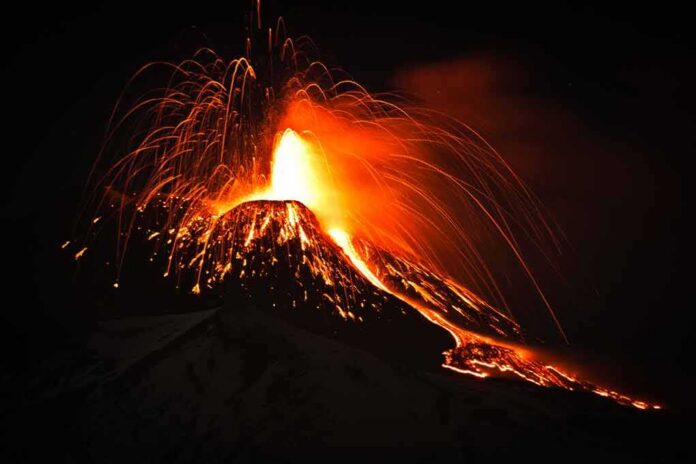
Guatemala’s Volcano of Fire roared back to life, forcing hundreds of villagers to flee in the dark as ash, lava, and deadly flows reminded the world how fast real danger can strike.
Story Snapshot
- Hundreds of Guatemalan villagers were evacuated after the Fuego volcano sent ash, lava, and pyroclastic flows toward their homes.
- National disaster officials declared an orange alert, closed schools and key roads, and moved families into emergency shelters.
- U.S. Embassy alerts named specific communities in the volcano’s path and warned residents to leave while escape routes were still open.
- Conflicting evacuation counts across news outlets expose how global media often skim past the hard details that matter for real accountability.
Volcano Erupts And Villages Move Out Of Harm’s Way
Guatemala’s Fuego volcano, known as the “Volcano of Fire,” erupted again, sending ash high into the sky and lava down its slopes as nearby villages rushed to get people out. The National Coordinator for Disaster Reduction, Guatemala’s main emergency agency, reported more than 700 residents evacuated from areas including Escuintla, Sacatepequez, and Chimaltenango. Independent outlets described ashfall, glowing lava, and deadly pyroclastic flows, the fast-moving clouds of hot gas and rock that can kill in minutes. These flows pushed officials to act before escape routes were cut off.
The emergency response focused on named communities directly in the path of the volcano’s activity. An alert from the United States Embassy said evacuations had begun for the villages of Panimache and El Porvenir in the municipality of San Pedro Yepocapa and warned that a main road, RN-14, was closed to protect travelers and clear the way for more evacuations if needed. Other reports listed Las Lajitas and nearby settlements, showing that officials were not issuing vague warnings but targeting real neighborhoods at risk.
Orange Alert, School Closures, And Shelter Operations
Guatemala’s disaster agency declared an orange alert, its second-highest level, signaling serious danger while the volcano continued to throw ash and lava. Relief reports say classes were suspended in multiple municipalities, a step that kept children off the roads and out of exposed school buildings. Authorities also closed RN-14, the road linking southern Guatemala to the tourist city of Antigua, to lower risk from ash, falling rock, and possible lava crossing. The same closure gave emergency crews space to move buses, supplies, and evacuees without traffic jams or curious onlookers in the way.
As families left their homes, buses carried them to town halls and sports centers converted into temporary shelters. Relief groups reported that humanitarian aid moved quickly from central government warehouses to these shelters, bringing food, water, and basic supplies for evacuees. Some outlets described people arriving with small bags and children in tow, remembering the deadly 2018 eruption that killed hundreds and pushed leaders to take warnings more seriously today. For conservative readers, this is a clear picture of local officials trying to act fast rather than waiting for distant global agencies or slow international panels to step in.
Confusing Numbers And Why Details Still Matter
One troubling pattern runs through the reporting: no one seems to agree on how many people were evacuated. Different outlets cite around 330, more than 500, over 700, nearly 900, and even 1,200 residents moved from the danger zone. These totals likely reflect different times, different cutoffs, or whether they counted only people in shelters versus everyone told to leave, but the effect is the same for the public. It becomes hard to know the real scale of the operation or judge how fully warnings reached those in harm’s way.
This confusion is not rare in disaster coverage. Fast-moving news wires like Reuters, Deutsche Welle, and other global channels tend to publish short summaries that balance gripping video with rough numbers. Their reports often repeat the figures given by the disaster agency and volcano monitoring office, with little room for deeper checks. Later technical summaries or relief notes may show different totals, but by then most readers have moved on. For people who value local control and honest government records, this should raise a red flag about how quickly headlines can simplify complex emergency decisions into one number that may never be fully explained.
Lessons For American Preparedness And Sovereignty
The Fuego eruption is far from our shores, but it sends a message that matters for American families and for President Trump’s push to restore competent government. First, the event shows how vital it is to keep real power close to home. Guatemalan agencies like CONRED and the national volcanic institute tracked the hazard, made the call on alerts, and moved people to shelters instead of waiting on distant global bureaucracies. That kind of local authority mirrors what conservatives want in the United States: strong state and county control, clear chains of command, and fast action based on facts, not slow-moving international panels.
Guatemala declared a red alert in Sacatepequez, Chimaltenango, and Escuintla due to a critical explosive phase at Fuego volcano, prompting the urgent evacuation of nearby communities, according to the National Coordinator for Disaster Reduction (Conred).
Conred Executive… pic.twitter.com/UeVvRwEg7I
— teleSUR English (@telesurenglish) August 5, 2026
Second, the story warns us about how large media outlets cover crisis events. They focus on dramatic footage and simple numbers while leaving out the deeper record that could reveal whether leaders truly served their people or just reacted to public pressure. For Americans, especially those in wildfire, hurricane, or earthquake zones, this means we must demand better transparency from our own agencies when alarms sound at home. Logs, shelter rosters, and real-time bulletins should be public so parents can judge for themselves whether it is time to grab their children and go.
Sources:
youtube.com, reuters.com, bbc.com, aljazeera.com, volcano.si.edu, reliefweb.int, facebook.com, watchers.news, ticotimes.net