
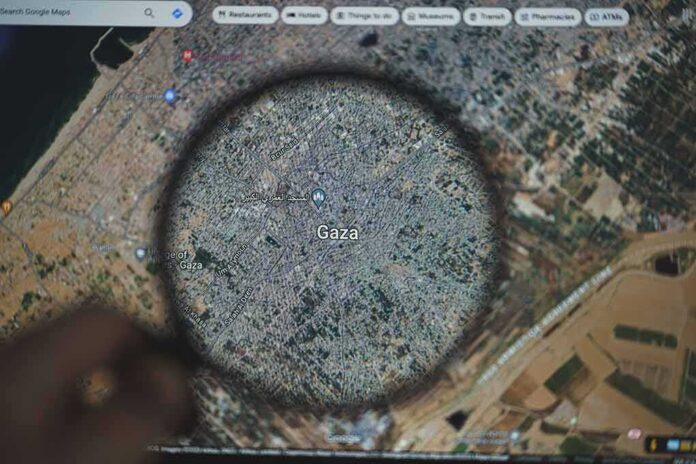
President Trump’s U.S.-backed Board of Peace unveiled a six-month, $2.45 billion blueprint with 66 projects to jump-start Gaza reconstruction and basic governance, aiming to restore order fast while guarding American interests.
Story Highlights
- Board of Peace proposes $2.45 billion, six-month plan with 66 projects.
- Early work targets temporary housing, rubble removal, hospitals, power, and water.
- Plan organizes efforts across six sectors, including security and infrastructure.
- Damage estimates top $35.2 billion; decade recovery projected at $71.4 billion.
What The Board Announced And Why It Matters
Associated Press reporting states the U.S.-backed Board of Peace presented a six-month, $2.45 billion plan to begin rebuilding and governing Gaza, formally unveiled at a board meeting as a 66-project starter blueprint. Axios reports the package is meant to move first on the basics: temporary housing, clearing rubble, repairing hospitals, and restoring power and water, while setting up a workable governing rhythm on the ground. The goal is early stability that can support longer-term rebuilding.
Axios adds that the plan divides work into six areas: infrastructure, human development, economic acceleration, digital transformation, legal affairs, and peace and security. This structure sets lanes for contractors, aid groups, and local managers so projects do not trip over each other. The plan also references repairs to crossings and utilities that link Gaza to trade and aid networks. Clear lanes, simple rules, and basic services can limit chaos, cut waste, and keep timelines short.
How The Numbers Fit The Bigger Picture
Axios places Gaza’s physical damage estimate at about $35.2 billion, with a full recovery path near $71.4 billion over a decade. A United Nations and European Union assessment in April projected a similar decade need of $71.4 billion and said $26.3 billion may be required in the first 18 months, showing how large the overall lift will be beyond the starter phase. Against that scale, the Board’s $2.45 billion plan is a first step to restore order and essential services fast, not the end state.
Brookings research explains that Gaza rebuilding only works when security, border access, funding, and governance move together, not in silos. That insight lines up with the Board’s sector approach and early focus on power, water, and crossings. The Board’s official framework says it will set rules and handle funding for redevelopment until a reformed Palestinian Authority can take over, which clarifies who is in charge during the initial phase. Clear responsibility can attract donors, speed permits, and reduce fraud.
Security, Governance, And American Priorities
Reports tied to the plan reference peace and security tasks and a potential multinational security role, aimed at protecting crews, materials, and key sites during the build-out. Past Gaza efforts stalled when materials got blocked, crews faced danger, or oversight broke down. The sector track for “peace and security” signals an intent to harden project sites and routes early, so aid reaches people and utilities stay online. Safe sites protect workers and taxpayers and reduce repeat damage.
The Board’s website describes a transitional model that keeps funding controls tight while local governance capacity grows. That matches lessons from policy studies that call for aligned security, border coordination with Israel and Egypt, and simple, verified money flows. The six-month window and 66 defined projects suggest a sprint: fix what keeps families alive and businesses open, then hand off to longer-term teams. That approach meets a core conservative test: set clear goals, deliver results, and guard every dollar.
What Comes Next And What To Watch
Media accounts do not list every funding pledge line by line, so the $2.45 billion reflects a defined starter program rather than a final multi-year budget. Implementation speed will rely on secure routes, equipment access, and partner buy-in. The Board’s choice to publish structure and priorities now gives industry, donors, and local managers a starting gun. If crews clear rubble, restore power, and reopen hospitals on schedule, families gain safety and markets can restart.
Sources:
military.com, pbs.org, anewz.tv, english.aawsat.com, wtop.com, brookings.edu, carnegieendowment.org