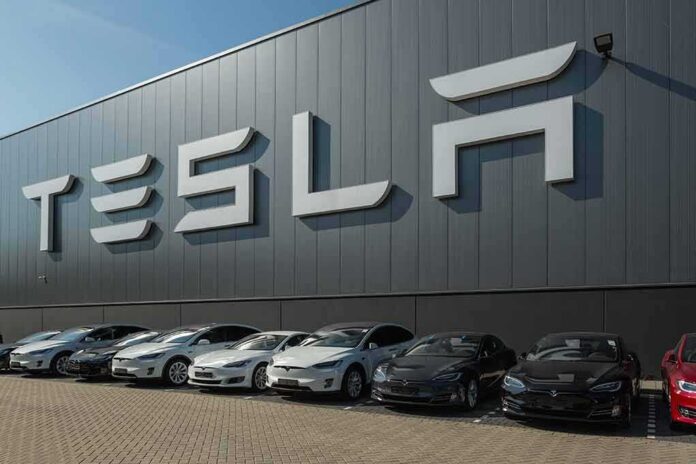
Tesla put a two-seat, steering-wheel-free “Cybercab” on Austin streets and says its robotaxi service now runs unsupervised across the entire metro area.
Story Highlights
- Tesla announced unsupervised robotaxi service across the Austin metro area.
- The Cybercab has two seats and no steering wheel or pedals, designed for full autonomy.
- Texas law treats the autonomous system as the legal driver and blocks city-level roadblocks.
- A formal Cybercab launch event in Austin follows the on-road testing phase.
Tesla Expands Unsupervised Robotaxis Across Austin
Tesla stated its robotaxi service is now unsupervised across the entire Austin metro area. The company’s official robotaxi account announced the expansion on social media. Reuters reported the same day that Tesla is rolling out unsupervised robotaxis in Austin, marking a major step for the service footprint and availability to riders who get access through Tesla’s app. The expansion builds on earlier pilot rides in the city, which began with limited deployments and safety supervision.
Texas gives Tesla a friendly runway. State policy centralizes oversight and preempts local rules that could block service. A legal explainer on Texas Senate Bill 2807 describes how the state defines the autonomous system as the driver, sets insurance rules, and bars cities from creating their own patchwork regulations. That framework helps companies launch and scale services without city-by-city fights that plagued other states and slowed past innovation.
Cybercab Design: Two Seats, No Wheel, No Pedals
Tesla’s Cybercab is built for autonomy from the ground up. Reports describe a two-seat cabin with no steering wheel and no pedals, reflecting a shift from driver assist to true driverless design. Motor1 reported Tesla confirmed a Cybercab launch event in Austin and highlighted the vehicle’s purpose-built layout with full reliance on onboard computing for navigation and control. Tech outlets and local coverage also documented on-road sightings during testing in Austin earlier this summer.
Early public road operations used a safety monitor in the passenger seat while the car lacked driver controls. Multiple reports from late June and early July noted the production Cybercab testing in Austin, including videos showing rides with no wheel or pedals and a human overseer riding shotgun for engineering validation. That step is common in autonomy rollouts as companies move from development to wider service while they refine routes, responses, and handoff logic.
What “Unsupervised” Means For Riders And Roads
“Unsupervised” signals no human chaperone in the vehicle and confidence in the software stack inside a defined service area. Reuters framed Tesla’s statement as a move to speed its autonomous ride-hailing operation in the Austin metro. Texas law helps by clarifying liability and enforcement. Under the state framework, the vehicle’s automated system is the driver, not the passenger, which simplifies roadside stops and crash reports and sets clear insurance needs for commercial operations.
Federal rules continue to adapt to vehicles without manual controls. The National Highway Traffic Safety Administration has recognized paths for manufacturers to certify vehicles that lack steering wheels and pedals, and has been working to clear old test procedures that assumed human controls. Legal analyses describe the updated interpretation that opened doors for self-certification approaches for automated vehicles designed without traditional driver interfaces. That policy evolution supports purpose-built robotaxis like the Cybercab.
Timeline: From Pilot Rides To Austin Launch Event
Media reports trace a steady march in Austin. TechCrunch reported Tesla offered rides without a human safety driver in the front seat after an earlier phase with a supervisor present in the passenger seat, part of a 2026 push to make robotaxis a real service for riders in the city. Reuters also reported Tesla slated a Cybercab-focused event in Austin, drawing attention to the product and the statewide operating climate that favors faster deployment compared to coastal regulatory regimes.
Federal developments point the same direction. Analysts note that the National Highway Traffic Safety Administration’s recent posture has reduced barriers for vehicles with no wheel or pedals. A prominent legal summary explains the agency’s shift away from rigid test procedures built for human-driven cars, which helps makers certify automated vehicles that never planned for a human to take over. That shift, paired with Texas preemption, signals a broader realignment that prizes innovation while keeping clear lines for safety and accountability.
Why This Matters For Families, Freedom, And Texas Growth
Texans want safer roads, faster commutes, and more choice. A driverless ride that shows up on time, costs less than legacy taxis, and serves more neighborhoods can help working parents, seniors, and veterans get where they need to go. State preemption protects that opportunity from city politics. With President Trump focused on energy, industry, and American innovation, Texas is showing how clear rules, not red tape, can bring new services to market and keep America in the lead.
Sources:
insiderpaper.com, teslarati.com, motor1.com, techcrunch.com, planetizen.com, phandroid.com, research.chalmers.se, www-nrd.nhtsa.dot.gov