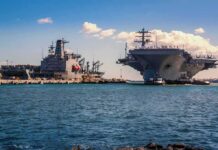
In a stunning military campaign that mainstream media has barely acknowledged, U.S. and Israeli forces have decimated Iran’s naval capabilities and killed top military commanders, yet critics continue to portray President Trump’s Operation Epic Fury as a strategic failure.
Story Snapshot
- Over 150 Iranian naval vessels destroyed in 27 days during Operation Epic Fury
- U.S. submarine achieves first torpedo ship-sinking since WWII, killing 87 Iranian sailors
- IRGC Navy Commander eliminated; Iranian ballistic missile capacity reduced by 86 percent
- Six U.S. troops killed in Iranian retaliatory strikes despite overwhelming American dominance
Historic Naval Destruction Unfolds
Operation Epic Fury launched February 28, 2026, marking an unprecedented military assault on Iran’s maritime forces. Defense Secretary Pete Hegseth confirmed that U.S. and Israeli strikes obliterated more than 150 Islamic Revolutionary Guard Corps naval vessels within less than a month. The campaign targeted underground facilities, missile production sites, and naval assets across Iran’s coastline. Hegseth declared the operation resulted in Iran having “no navy, no leader,” emphasizing that never in recorded history has a nation’s military been neutralized so rapidly. The scope extends beyond traditional Middle Eastern conflict zones into the Indian Ocean.
Rare Torpedo Attack Marks Naval Warfare Revival
On March 4, 2026, a U.S. submarine torpedoed the Iranian warship IRIS Dena off Sri Lanka’s coast in international waters, marking the first submarine torpedo sinking since World War II. The attack killed 87 Iranian sailors, with 32 rescued by Sri Lankan authorities and dozens remaining missing. The IRIS Dena had been sanctioned in 2023 for transporting drones to Russia for use against Ukraine. Admiral Brad Cooper confirmed initial reports of at least 17 Iranian vessels sunk in early operations. Iran Navy Chief Shahram Irani vowed “deadly strikes” in retaliation on March 17, though the IRGC Navy commander was subsequently killed in Israeli strikes.
Strategic Military Degradation Accelerates
U.S. military officials report destroying over 10,000 Iranian military targets during the 27-day campaign. General Dan Caine confirmed an 86 percent reduction in Iranian ballistic missile launch capacity and a 73 percent decrease in kamikaze drone capabilities. The strikes systematically dismantled Iran’s defense industrial base, targeting weapons production facilities and command structures. Despite overwhelming U.S. tactical dominance, Iranian forces killed six American troops in retaliatory attacks on regional bases. Defense officials acknowledge U.S. military capabilities continue rising while Iran’s offensive projection has collapsed, though Iranian leadership structures remain largely intact according to intelligence assessments.
The stark disconnect between battlefield realities and political narratives raises fundamental questions about how Americans receive information during military conflicts. While the Pentagon documents historic Iranian losses—vessels destroyed, commanders eliminated, weapons systems degraded—public discourse remains fixated on political controversies rather than strategic outcomes. This pattern reflects broader frustrations among citizens who question whether government officials and media institutions prioritize factual reporting or political agendas. The operation’s success in neutralizing immediate threats contrasts with lingering concerns about long-term regional stability, American casualty risks, and the absence of visible Iranian internal opposition to the regime despite catastrophic military losses.
Sources:
Iran International – Iran Navy Chief Vows Retaliation
U.S. Department of War – Hegseth Relays Death of Iranian Navy Commander
TIME – United States Sinks Iranian Warship Pentagon Briefing
Kyiv Post – Iranian Naval Vessel Coverage