

Homeland Security’s public dismissal of a veteran border commander amid Newark detention-facility unrest spotlights a deeper fight over law-and-order priorities and who is protecting frontline officers.
Story Snapshot
- Greg Bovino criticizes federal leadership over Newark detention-facility unrest; says weak command endangered officers [2].
- Homeland Security Secretary Markwayne Mullin downplays Bovino, touts interagency coordination and contingency plans [1].
- Dispute reflects a broader pattern where immigration flashpoints become credibility battles over crowd control and cause [2].
- Trump-era expectations for firm enforcement clash with claims of limited state and local resources at key moments [1].
What sparked the clash at the Newark detention facility
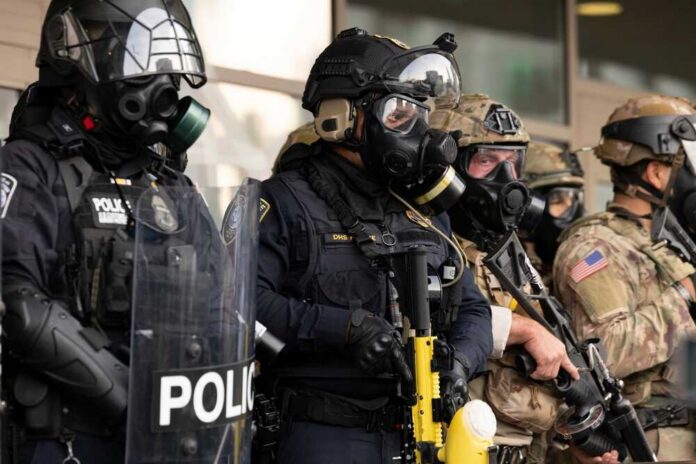
Former Border Patrol chief Greg Bovino publicly argued that unrest around the Newark immigration detention facility escalated because Department of Homeland Security leadership failed to project strength and preparedness, leaving Immigration and Customs Enforcement officers exposed to risk [2]. Bovino traveled to New Jersey and criticized the response while telegraphing his intent to “handle” the situation, framing the incident as evidence that hesitant command decisions embolden agitators and complicate officer safety at facilities already strained by immigration-related tensions [2].
Supporters of firm enforcement policies see Newark as a test of whether the federal government will back the badge without apology. Bovino’s argument hinges on deterrence: that visible, confident leadership and rapid reinforcement reduce chaos before it spreads. He contends the opposite happened, citing the on-the-ground volatility and the need for stronger posture to keep detainee operations, transport, and perimeter security stable under protest pressure [2]. His critique resonates with readers weary of years of permissive border policies and soft-on-order narratives.
How Secretary Mullin defended the federal response
Homeland Security Secretary Markwayne Mullin publicly dismissed Bovino as “irrelevant,” while describing the Newark response as an active, cooperative effort balancing federal, state, and local roles [1]. Mullin said state and local departments lacked sufficient resources to fully absorb the burden and indicated federal personnel might be redirected to protect their own staff, emphasizing that a contingency plan was in place for redeployment and coordination [1]. He also described the governor, mayor, and police chief as cordial partners in managing the situation [1].
Mullin’s account frames Newark as a resource-allocation problem, not a leadership vacuum. He depicted federal decision-making as pragmatic triage under real constraints, with interagency agreements and fallback plans ready if local capabilities ran short [1]. That posture counters Bovino’s claim of softness by arguing that measured scaling, not chest-thumping, preserves safety and order. Still, the acknowledgment of thin local capacity raises hard questions for readers: Why are critical facilities dependent on last-minute reallocations rather than predictable surge readiness?
Why the Bovino-Mullin dispute matters to conservative readers
Immigration enforcement flashpoints routinely split into dueling narratives: one stressing crowd violence and officer danger, the other highlighting overreach or mismanagement, with each side racing to define events before formal records emerge [2]. Newark fits that pattern, turning into a credibility contest over what kept officers safe and what may have emboldened agitators. Bovino’s critique aligns with a law-and-order baseline: strong deterrence, rapid reinforcement, and political leaders who do not grandstand near volatile facilities during tense operations [2].
For a conservative audience, the stakes go beyond one facility. Readers expect the federal government, now under a second Trump term, to end the drift of past years: no more mixed signals on enforcement, no tolerance for crowd intimidation of officers, and no operational surprises when protests flare. Mullin’s emphasis on cordial coordination and contingency plans acknowledges real constraints, but it also underscores a core demand from the right: predictable readiness that protects officers first, deters disruption, and restores confidence that the rule of law will be upheld [1].
Sources:
[1] YouTube – Gov. Mikie Sherrill is ‘also an anarchist’: Fmr. Chief Border Patrol …
[2] Web – Feds go after one of their own: Bovino loses fight as Mullin moves in