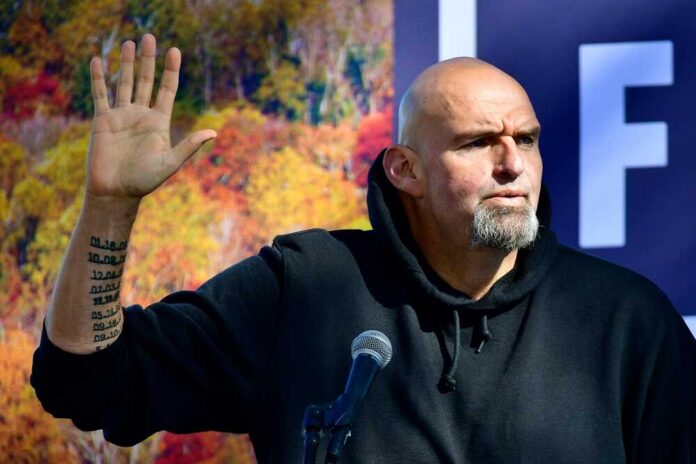
One Democrat’s blunt “moral clarity” message on Israel and Iran is exposing a political fracture that’s now colliding with a punishing shutdown—and raising fresh questions for MAGA voters about war powers and Washington priorities.
Quick Take
- Sen. John Fetterman says his support for Israel—and backing a U.S.-Israeli operation targeting Iran—comes from “moral clarity,” not party loyalty.
- Fetterman argues the Democratic Party is “fracturing,” with Israel as the central dividing line.
- He condemns the prolonged federal shutdown as an attack on working Americans, pointing to unpaid TSA agents.
- His criticism extends to far-left influence in Democratic politics, including figures he describes as “socialist” or “pro-Iran.”
Fetterman’s break centers on Israel, Iran, and a party “fracturing”
Sen. John Fetterman (D-Pa.) told Fox News host Mark Levin that “moral clarity” is driving his widening split with his party, especially on Israel. Fetterman described a Democratic “fracturing” where Israel has become the main fault line, and he pressed a basic question: “Democrats have to decide, whose side are you on?” His stance includes backing Operation Epic Fury, a joint U.S.-Israeli military campaign aimed at Iran.
For conservatives watching this unfold in 2026 under a second Trump term, the unusual part is not simply that a Democrat is defending Israel; it’s that he’s defending a higher-tempo U.S. role against Iran while his party publicly splinters. It does not include detailed operational specifics about Operation Epic Fury beyond its description as a U.S.-Israeli campaign, so the scope and congressional authorization status cannot be verified from these sources alone.
A shutdown past 40 days puts federal workers in the crossfire
Fetterman also used the interview to condemn the federal government shutdown that has stretched beyond 40 days. He framed the stalemate as an immediate, tangible harm to everyday workers who aren’t part of Washington’s political games—especially Transportation Security Administration employees who still have bills due even when paychecks stop. It describes the shutdown dispute as tied to DHS/ICE funding and Democratic demands for ICE reforms.
That worker-first argument lands in an uncomfortable place for both parties. Conservatives who remember years of “woke” spending priorities and inflation from fiscal mismanagement are now also watching federal dysfunction hit basic services and household stability. Fetterman’s point, as presented in the cited interview coverage, is that shutdown tactics punish the wrong people first. The research does not provide updated negotiations or a firm end date, only that no resolution was in sight at the time.
Far-left influence and the “pro-Iran” label intensify the internal fight
Fetterman pointed to far-left activism as part of what he rejects, singling out streamer Hasan Piker’s prominence in Democratic circles. According to the provided research summary of Fetterman’s remarks, he criticized the idea that Democrats would campaign alongside figures accused of defending Hamas or trafficking in antisemitic rhetoric, and he said he may have “lost the socialist vote and the pro-Iran vote.” Those characterizations are presented as Fetterman’s argument, not independently documented in the supplied sources.
Politically, this dispute matters because it links foreign policy, culture, and party identity in one blunt conflict: Israel support versus progressive activism, and national security versus ideological signaling. For conservative readers who feel the country has been pulled toward globalist priorities and elite narratives, the irony is that a Democrat is now making a case for clearer lines on terrorism-adjacent rhetoric and for protecting paychecks of frontline workers—while party leadership struggles to unify its own coalition.
What this means for Trump’s second term—and a MAGA base split on new wars
The interview arrives at a moment when many Trump voters are divided about deeper U.S. involvement in an Iran conflict and are newly willing to question long-standing assumptions about foreign entanglements. It highlights Fetterman’s support for Operation Epic Fury, but they do not include a parallel explanation of the Trump administration’s decision-making process, legal rationale, or congressional consultation. That gap matters to constitutional conservatives who prioritize Congress’s war powers and clear accountability.
Fetterman’s “moral clarity” framing is a political weapon inside the Democratic Party, but it also pressures Republicans and the Trump White House to explain objectives, limits, and endgames. A coalition that’s tired of “endless regime change wars” is not automatically persuaded by moral language alone; it demands measurable goals and defined boundaries. The clearest verified takeaway is narrower: the Israel-Iran divide is widening in U.S. politics, and even Democrats are openly battling over it.
REBEL RANKS: Sen. John Fetterman says "moral clarity" over his support for Israel and opposition to the ongoing government shutdown drives his widening break with the Democratic Party.
"Democrats have to decide, whose side are you in?" pic.twitter.com/yLMuuS68Bd
— Fox News (@FoxNews) April 6, 2026
As Washington fights on multiple fronts—foreign policy tensions with Iran, a shutdown hammering federal workers, and a cultural civil war inside the Democratic coalition—conservatives should keep the focus on constitutional guardrails and practical outcomes. It documents Fetterman’s remarks and the political shockwaves they’re causing, but they also show how little hard detail is being offered in the public arena about the operation itself, even as Americans absorb the costs and risks.
Sources:
https://www.foxnews.com/media/fetterman-says-moral-clarity-drives-widening-break-democratic-party
https://www.foxnews.com/video/6392587381112