
A single sentence from Air Force One cracked open a promise that has quietly underwritten Taiwan’s survival since Ronald Reagan.
Story Snapshot
- President Trump said he discussed U.S. arms sales to Taiwan with China’s Xi Jinping during a Feb. 4 phone call, then hinted a decision would come “pretty soon.”
- The comment collided with the 1982 “Six Assurances,” which explicitly said the U.S. would not consult Beijing about arms sales to Taiwan.
- The White House quickly insisted policy had not changed, citing the Taiwan Relations Act, the U.S.-China communiqués, and the Six Assurances.
- Reports of a potential roughly $20 billion Taiwan package and a looming Trump trip to China turned routine arms notifications into high-stakes bargaining signals.
The Air Force One remark that set off alarms in Taipei and Washington
President Trump told reporters on Feb. 17 that he had talked with Xi Jinping about U.S. arms sales to Taiwan and that the two leaders had a “good conversation,” with a determination coming soon. That matters less for the tone than for the precedent: a U.S. president publicly acknowledging consultation with Beijing about arming Taiwan. The White House moved fast the next day to say the underlying policy framework remained unchanged.
The speed of that cleanup tells you the administration understood the risk. Taiwan arms sales are never just procurement. They are a credibility test that allies watch and adversaries measure. When a president speaks loosely, bureaucracies scramble because China treats ambiguity like an opening bid. Taipei, meanwhile, hears every nuance as a question about whether deterrence can be postponed without inviting pressure.
The 1979 law and the 1982 pledge that Beijing was not supposed to influence
Two pillars drive the U.S. approach. The Taiwan Relations Act of 1979 commits the United States to help Taiwan maintain a sufficient self-defense capability after Washington switched diplomatic recognition to Beijing. The “Six Assurances” of 1982 added political guardrails, including a clear statement that the United States would not consult China in advance about arms sales to Taiwan. That pledge was designed to keep Beijing from holding Taiwan’s defense hostage.
Trump’s comment did not automatically rewrite those pillars, but it brushed against their purpose. Consultation, even if informal, creates leverage for China. It encourages Beijing to treat Taiwan’s defensive needs as a tradable commodity alongside tariffs, agricultural purchases, or other deal points. From a conservative, common-sense standpoint, deterrence fails when it becomes negotiable. Commitments keep peace precisely because they are not reopened every time a summit approaches.
Why the timing matters: trade leverage, summit optics, and a rumored mega-package
The call and Trump’s later remarks landed amid reports that the United States was preparing a major arms package for Taiwan, potentially including high-end air and missile defense. At the same time, a Trump trip to China hovered on the calendar, making every delay look like a concession and every approval look like a provocation. Analysts tracking the process noted that, as of April, no massive package had been formally sent to Congress.
That gap fuels the most plausible interpretation: tactical slowdown rather than strategic reversal. Presidents often manage timing to reduce friction ahead of meetings. The danger is that “timing” becomes habit, and habit becomes policy without a vote. China has a long record of testing whether U.S. resolve is elastic. If Beijing senses arms approvals can be slowed by raising the temperature, it will raise the temperature more often.
Congress, contractors, and Taiwan’s clock: who can force the issue
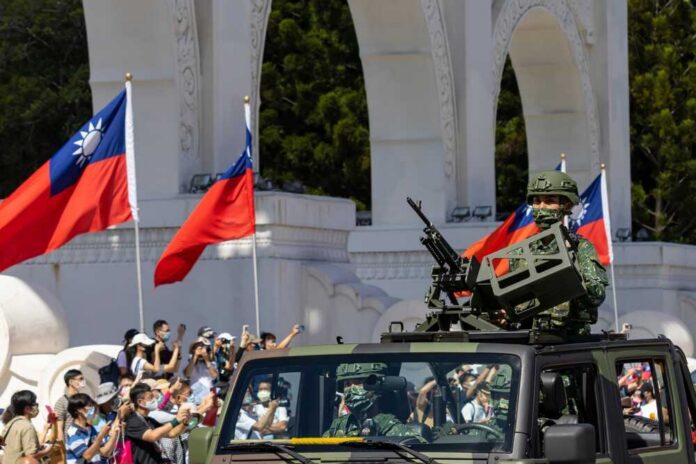
Even a president who loves one-on-one diplomacy does not control the entire chessboard. Congress retains strong influence through oversight and broad bipartisan support for Taiwan’s defense, and lawmakers can raise political costs for extended delays. U.S. defense firms also feel the signal value because slow notifications and delivery backlogs disrupt planning and weaken deterrence through uncertainty. Taiwan, for its part, has expanded defense spending and tries to buy capabilities that complicate invasion plans, not trophies for parades.
Taiwan’s real constraint is time. Delays do not just push paperwork; they stretch training pipelines, parts supply, and integration into a coherent defense plan. Patriot-type air defense, coastal denial systems, and resilient command-and-control matter most when they arrive early enough to be absorbed. From a U.S. national-interest lens, arming a partner to prevent war is cheaper than responding after a crisis erupts in the world’s most economically vital sea lanes.
What Trump’s deal-making style could mean for deterrence going forward
Trump’s defenders argue he uses leverage bluntly and then delivers results, pointing to his first term approvals of major Taiwan sales despite Chinese objections. Critics argue that mixing Taiwan into broader bargaining invites Beijing to demand “prudence” as the price of progress elsewhere. The strongest factual reading from available reporting supports a middle ground: Trump publicly entertained the topic with Xi, while his White House emphasized continuity to contain market, ally, and congressional blowback.
The open question is whether Beijing interprets the episode as theater or as a crack in the wall. Deterrence depends on what China believes, not what Washington intends. The conservative policy instinct here is straightforward: peace through strength requires predictable commitments, not improvisation. If a temporary slowdown truly serves a larger strategic outcome, it must be paired with visible follow-through, not indefinite “determinations pretty soon.”
The next tell will not come from rhetoric but from process: whether a major package is notified to Congress after the China trip window, and whether the administration treats the Six Assurances as living guardrails or as optional talking points. Taiwan watches the calendar. China watches the seams. America’s allies watch whether U.S. promises hold when a phone call turns into a negotiation opportunity.
Sources:
Will Trump Continue to Slow Arms Sales to Taiwan?
Trump, Xi discuss Taiwan arms sales; White House says policy unchanged