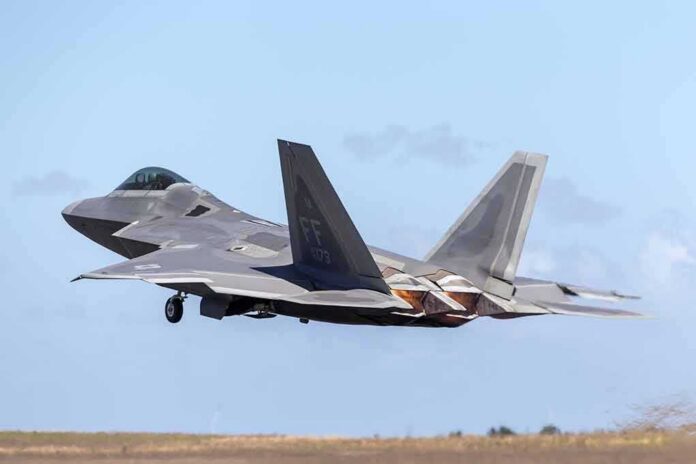
Faced with a projected $66 billion price tag for a carrier-capable F-22 “Sea Raptor,” the Navy chose the far cheaper F/A-18 Super Hornet and got combat power to the fleet on time and within its development cap.
Story Highlights
- The Navy formalized the Super Hornet program in 1992 as a structured upgrade, not a new-start gamble.
- Congress set a strict development cap of $4.88 billion in 1990 dollars, and the program held to it.
- Program reports cite total costs in the tens of billions, with hundreds of jets delivered to the fleet.
- Carrier-proofing an F-22 would have driven costs and design risk far higher than the Super Hornet path.
Why the Navy Picked the Super Hornet Over a “Sea Raptor”
Congress and Navy leaders needed a carrier fighter that could deploy sooner, cost less, and still add range, payload, and survivability. The Super Hornet fit that plan. The Defense Acquisition Board approved engineering and manufacturing development in May 1992, locking in a disciplined path that built on the proven Hornet line rather than starting from scratch. A carrier-ready F-22 would have required deep structural changes, which drive delay, risk, and price.
Turning an Air Force stealth jet into a carrier aircraft is not a paint job. Arrested landings and catapult launches demand stronger landing gear, a redesigned wing box, and a tailhook system that works on a pitching deck. Those changes add weight and threaten stealth shaping. Analysts tied earlier F-22-to-carrier concepts to rising gross takeoff weight, which exceeded what carriers were built to handle at the time. The Super Hornet avoided that trap by starting with a carrier-native design.
A Tight Budget Cap—and a Program That Met It
Congress capped Super Hornet development at $4.88 billion in 1990 dollars and ordered that unit costs not exceed 125 percent of legacy F/A-18C/D jets. This ceiling forced real discipline. Government auditors traced the Super Hornet’s roots to the 1988 Hornet 2000 study and recorded the program’s May 1992 “Major Modification” approval, reinforcing that this was an upgrade strategy, not a blank-check redesign. That structure helped deliver capability increases while protecting taxpayers.
Public reports from the period show that the Navy and Congress kept steady watch on costs and schedules. By the late 1990s, advocates highlighted that the program stayed inside its original cost and schedule, a record that is rare in defense aviation. That record mattered then and still matters today. It shows a model for how to modernize without surrendering to the culture of endless overruns that drains readiness and crowds out other needs.
Fielding at Scale: Planes to the Fleet, Not Studies on a Shelf
The strategy paid off in jets on deck. Selected Acquisition Reports and oversight tallies show the Navy received more than 500 Super Hornets by 2013, giving carriers a reliable workhorse across missions, from air defense to strike. Congressional research also tracks hundreds procured through the 2000s as part of multiyear buys, which further reduced costs and stabilized production for the fleet. This is the practical path: buy what flies, sustain what wins, and keep costs in check.
By contrast, a “Sea Raptor” would have swallowed time and money. Navalizing the F-22 would have forced major redesign for deck life and launch-recovery stress, with ripple effects on stealth, maintenance, and logistics. Those realities are why the Navy chose a carrier-first design and why Congress insisted on hard caps. It is not glamorous, but it protects warfighters, taxpayers, and the industrial base that keeps carriers lethal in contested seas.
Sources:
19fortyfive.com, everycrsreport.com, globalsecurity.org, gao.gov, ft.dk, anao.gov.au