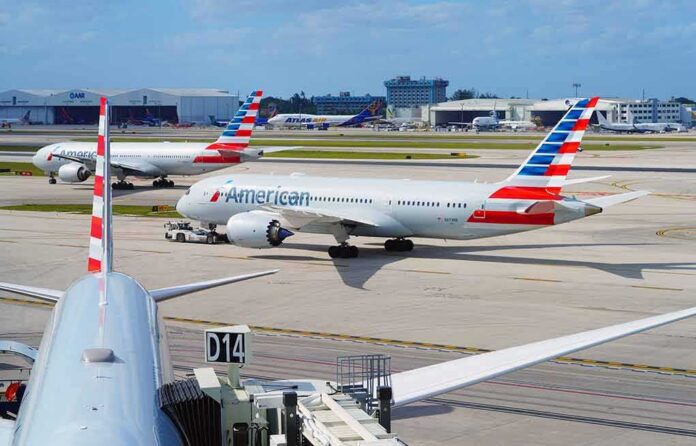
A passenger’s laptop battery reportedly ignited on approach to Dallas/Fort Worth, filling the cabin with smoke before flight attendants contained it and the jet landed safely.
Story Highlights
- American Airlines said Flight 2398 landed safely at Dallas/Fort Worth after smoke from a customer’s device.
- Federal officials described a laptop battery fire contained with a thermal bag as the plane neared landing.
- The crew taxied to the gate for responders; at least one passenger received treatment and was released.
- Air traffic control audio captured the pilot reporting multiple burn injuries during the incident.
Safe Landing After In-Flight Device Fire
American Airlines said Flight 2398 from Atlanta to Dallas/Fort Worth landed safely after crew reported smoke from a customer’s device during landing. Federal reporting cited by local outlets identified the problem as a laptop battery fire in the cabin. Flight attendants used a thermal containment bag to control the device and stop further spread. The aircraft arrived around 6:55 p.m. and did not require an evacuation. The crew coordinated a taxi to the gate to meet emergency responders.
Airport officials and local coverage reported that at least one passenger was treated on the scene and released. Earlier radio calls captured by outlets quoted the pilot estimating four to five burn injuries, which set a higher early count. The final confirmed number of injuries has not been published by officials. Reports consistently identify the flight as American Airlines 2398 and place about 133 people on board during the incident to Dallas/Fort Worth.
What The Pilot And Airline Reported
Air traffic control audio shared in coverage recorded the captain reporting “a cabin fire in the back of the airplane” and estimating “four to five passengers” burned by the laptop. The airline’s statement focused on a safe landing and a customer device that produced smoke during arrival. That difference is common in fast-moving safety events, where on-scene estimates can exceed later counts. Local coverage emphasized that the crew’s quick action kept the situation from escalating on the ground.
Local television outlets reported the jet taxied to the gate rather than stopping on a runway or remote taxiway. That detail suggests the crew and responders did not view the situation as an ongoing fire threat after containment. American Airlines’ statement did not name the passenger whose device failed. No brand or model of laptop has been confirmed in the available reporting. The cause beyond a suspected lithium-ion battery failure has not been formally released.
How Crews Fight Lithium Battery Fires In Cabins
Flight attendants train for battery fires because overheated cells can vent gas, smoke, and flames. Crews use water or non-alcoholic liquids to cool the device and then place it into a thermal containment bag to reduce heat and manage smoke spread. Federal Aviation Administration materials warn that these events, while uncommon compared to total flights, have risen in recent years, with record incident counts reported in 2024, most on passenger aircraft.
The Federal Aviation Administration publishes guidance to airlines about lithium battery risks and cabin procedures. Industry summaries citing Federal Aviation Administration data reported dozens of laptop-related incidents in recent tallies, highlighting why bags and training are now standard. The key is speed: cool the device, isolate it, and monitor for re-ignition. That sequence mirrors what flight attendants reportedly did on Flight 2398 as the aircraft approached Dallas/Fort Worth.
Why This Matters To Travelers And Families
Families rely on safe, orderly flights, and they expect problems to be contained fast. This case shows trained crews and the right tools can keep people safe even when a device fails. The plane landed, taxied to the gate, and responders handled injuries. That outcome is a win for common-sense safety, not headline drama. It also reinforces personal responsibility: watch your devices, avoid crushing bags under seats, and follow crew instructions when charging or storing electronics.
Conservatives value order, preparation, and accountability. Travelers deserve straight facts, not spin. Here, the facts show a real hazard that was controlled by trained Americans doing their jobs. The Federal Aviation Administration and airlines should continue clear rules to limit risky batteries and counterfeit chargers that cause heat and smoke. Passengers can help by reporting hot or smoking devices immediately and by keeping laptops and spare batteries where crew can reach them quickly if something goes wrong.
What We Know And What Is Next
Based on reporting, American Airlines Flight 2398 carried about 133 people, landed safely at Dallas/Fort Worth, and met responders at the gate after flight attendants contained a laptop battery fire with a thermal bag. At least one passenger was treated and released at the airport. The captain’s radio call referenced four to five burn injuries, but a final injury count has not been published in the available material. Officials have not released the device brand or a formal root-cause report.
Sources:
youtube.com, cbsnews.com, instagram.com, facebook.com