
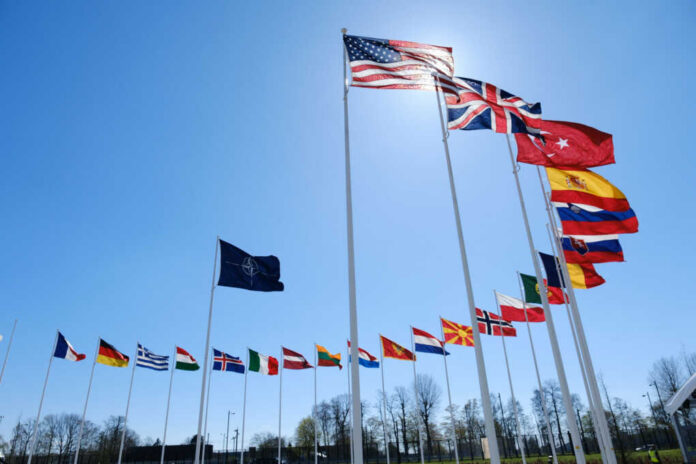
President Trump’s fiery threats to abandon NATO expose European allies’ freeloading, forcing a reckoning on America’s endless defense subsidies amid skyrocketing oil prices from Iran’s blockade.
Story Highlights
- Trump blasts NATO as a “paper tiger” after Europe refuses to help clear Iran’s Strait of Hormuz blockade following US-Israel strikes.
- Shaky ceasefire holds, but oil shocks persist as allies offer only weak patrols instead of real support.
- US leverages 100,000 troops in Europe to demand burden-sharing, threatening relocation to cooperative nations.
- Critics call threats “stupid,” yet they pressure Europe toward self-reliance after decades of US overcommitment.
Trump’s NATO Confrontation Escalates
On April 10, 2026, President Trump berated NATO Secretary General Mark Rutte in a meeting over allies’ inaction during the recent US-Israel war with Iran. Trump followed with an all-caps Truth Social post: “NATO WASN’T THERE WHEN WE NEED THEM, AND THEY WON’T BE THERE IF WE NEED THEM AGAIN.” The next day, April 11, he labeled NATO allies “cowards” for griping about high oil prices without aiding Strait of Hormuz clearance. This marks a sharp escalation tied directly to the war’s fallout, unlike past spending disputes.
War Origins and Europe’s Refusal
US-Israel strikes on Iran began February 28, 2026, without consulting NATO allies, killing thousands and prompting Iran’s blockade of the Strait of Hormuz. The blockade spiked global oil prices, disrupting shipping and energy markets. Trump secured a shaky ceasefire around April 8-9, but Iran maintains the blockade. European nations refused forceful clearance, offering only potential patrols. Britain granted limited US base access for defensive strikes, but no broader commitments emerged. Europe decries the war as reckless and illegal, prioritizing domestic economic stability.
Marco Rubio, US Secretary of State, echoed Trump’s frustration, questioning NATO’s one-way street: “If NATO is just about us defending Europe… that’s not a very good arrangement.” Trump added, “Without the U.S.A., Nato IS A PAPER TIGER!” These statements highlight power imbalances, with the US stationing nearly 100,000 troops under NATO’s nuclear umbrella while allies freeload.
Strategic Value Amid Tactical Flaws
NATO, founded in 1949, depends on US military dominance. Article 5’s flexible wording—”such action as it deems necessary”—has evolved into a perceived US guarantee for Europe. Trump’s long-standing critiques, from his first term, demand 2% GDP defense spending and reject “forever wars.” Even as threats appear misguided, they usefully erode US overcommitment. The White House considers shifting troops from uncooperative nations, signaling de facto disengagement without formal exit. This exploits war fallout to renegotiate alliances.
Impacts on America and Beyond
Short-term, oil shocks roil US markets and strain alliances via potential troop moves. Long-term, these pressures could dismantle NATO’s automatic US defense pledge, fostering European self-reliance. Conservatives applaud reduced overcommitment, aligning with America First principles of limited government abroad. Yet transatlanticists warn of security risks. Europe faces economic depression and radicalization from high energy costs, while global displacement affects millions. Both sides share frustration with elite-driven foreign entanglements that burden working Americans.
Pro-Trump views see legitimate pushback on freeloading; critics fear alliance collapse. With Republicans controlling Congress, Trump holds leverage against Democratic obstruction. This episode underscores bipartisan distrust in a federal government more focused on elite interests than citizens chasing the American Dream through hard work.
Sources:
Threatening NATO Over Iran Is Stupid, but Potentially Useful
Trump calls NATO ‘cowards’ over lack of support in US-Israel war on Iran
Will the Iran War End the NATO Alliance?
Before striking Iran, Trump should answer these six questions