

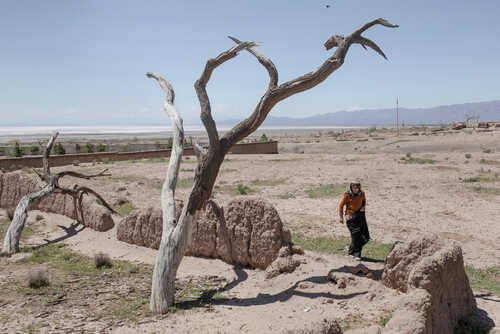
Tehran is on the brink of an unprecedented crisis as its water reservoirs approach depletion, threatening the capital’s 15 million residents with a “day zero” scenario and possible evacuation. This alarming development, underscored by President Masoud Pezeshkian’s recent warning, highlights chronic issues in water management, exacerbated by climate change and systemic governance failures. Analysts now view Iran’s water scarcity as a profound political and security problem, raising concerns over potential mass unrest.
Story Overview
- Tehran’s water reservoirs are nearly empty, sparking fears of a “day zero” scenario.
- Iranian President warns of possible evacuation if water conservation measures fail.
- The crisis underscores systemic governance failures and climate stress.
- Potential evacuation of parts of Tehran marks a significant political and security issue.
Tehran’s Water Crisis: A Looming Threat
Tehran is on the brink of an unprecedented crisis as its water reservoirs approach depletion. The Iranian capital, housing around 15 million people, could face a “day zero” scenario where taps run dry. President Masoud Pezeshkian has urged citizens to reduce water usage and warned that partial evacuation might be necessary if the situation does not improve. This alarming development highlights chronic issues in water management, exacerbated by climate change and over-extraction.
The security dimension of this crisis cannot be overstated. Analysts have identified Iran’s water scarcity as a profound political and security problem, suggesting that the crisis is not merely a technical issue but one of national stability. The potential for mass unrest in response to service interruptions and rationing is a real concern, posing significant challenges for Iranian leadership.
Tehran may be evacuated as taps run dry due to water crisis
The Iranian people have been misled by their own leadership. Foreign misadventure taking precedent over domestic problems. Iran, your suffering will continue!
— Muchmore Inghams (@JohnnyRaptor20) December 5, 2025
Systemic Governance Failures
Iran’s current predicament stems from decades of mismanagement and poor water policy. The emphasis on large dams and irrigation expansion post-1979 significantly increased water demand. Over-pumping of groundwater has further depleted resources, creating a hidden crisis that is now coming to the fore. Subsidized water and energy policies have encouraged wasteful irrigation, compounding the problem.
Tehran’s reliance on a mix of dams, inter-basin transfers, and dwindling groundwater sources has left the city vulnerable. Reduced snowpack and high upstream demand have led to declining inflows, while the infrastructure struggles under economic strain. The lack of effective demand management and enforcement against illegal water extraction has exacerbated Tehran’s water woes.
Political and Social Ramifications
The political implications of Tehran’s water crisis are significant. Failure to secure basic services undermines government legitimacy and could delegitimize leadership, especially if seen as a result of corruption or mismanagement. The crisis may fuel intra-elite debates over resource allocation and lead to calls for structural reform in water governance.
Socially, the crisis poses risks of heightened anxiety and stress among residents. Inequality in access to water may exacerbate tensions, with wealthier neighborhoods better positioned to secure private storage and deliveries. The potential for urban unrest looms large, with water shortages historically triggering protests in Iran.
Watch the report: Major city in Iran may have to evacuate as water supplies run low
Sources:
The Soufan Center: Iran’s water crisis as a profound political and security problem
Iran counting down to ‘day zero’ as capital runs out of water
Major city may have to evacuate as water supplies run low | World News