
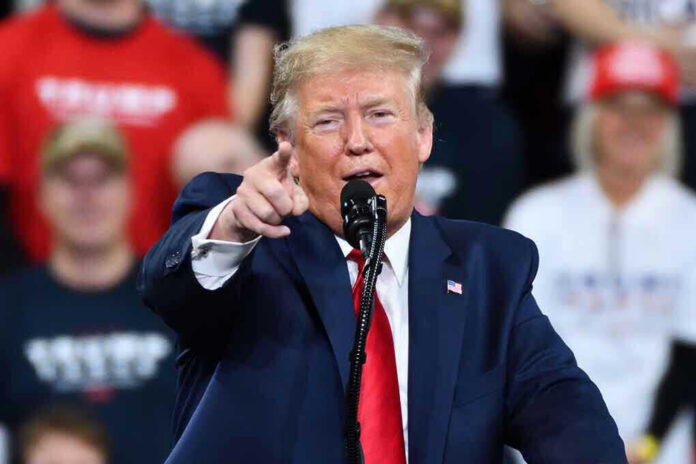
Viral clips show President Trump telling a CNN reporter to “be quiet” and calling her “fake news” during an on-camera White House exchange, reigniting debate over hostile media tactics and decorum.
Story Highlights
- Video shows Trump interrupting a CNN reporter, saying “be quiet” and “fake news.”
- Clips and coverage identify the reporter as CNN’s Kristen Holmes.
- The exchange happened on camera during a White House policy event.
- Past records show transcripts of similar clashes were later corrected.
What The Video Shows In The Oval Office Exchange
Public video clips capture President Trump cutting off a female reporter, repeating “Quiet. Be quiet,” and asking whom she represented. When she said CNN, he called her “fake news” and a “fake reporter.” The exchange is audible and on camera, making the core words plain to viewers. The tone is firm and dismissive, which tracks with past Trump-media showdowns. These details stem from widely shared footage that features the dialogue in real time.
Coverage names the reporter as CNN’s Kristen Holmes, consistent with what viewers hear when she identifies her outlet during the exchange. Several outlets describe the scene as an Oval Office or White House press moment, not a hallway ambush. The clips do not show the full event from start to finish, but the key words are clear. In the video, Trump also frames the interruption as a push for order and respect during the event, not a back-and-forth debate.
Context Around The Question And Event Setting
Reports say the exchange came during a White House event where policy questions surfaced. Some clips tie the moment to defense or foreign policy topics, such as military exercises or naval operations. The exact subject of the reporter’s question varies across short posts, which is common with clipped videos. What is consistent is the setting, the press presence, and the audible remarks. The core focus is Trump’s command to “be quiet” and his labeling of CNN as “fake.”
Video also shows Trump saying the reporter was “very disrespectful” in front of a young person present. That detail underscores how Trump justified the tone he used in the room. Supporters view this as a pushback against media grandstanding. Critics see it as needlessly personal. The camera angle and mic placement keep the focus on the exchange, not the full room. Still, the words heard on the clip are not in dispute across outlets that reposted it.
Why Transcript History Matters For The Record
Past incidents show that official transcripts have, at times, softened or altered tense moments, and were later corrected. In a notable 2018 example, the White House first released an incomplete account of Trump’s jab at ABC’s Cecilia Vega, then updated the transcript to include the line in question. That pattern explains why today’s coverage leans on video as the anchor for the exact wording. The camera gives a fixed record, which limits spin from either side.
This latest clash fits a known pattern: combative exchanges with certain outlets, followed by viral clips and heated headlines. Conservatives have watched corporate media push narratives that ignore policy wins and fixate on tone. The result is a loop that helps ratings but not public understanding. Clear records matter because they stop selective quoting. When the words are on tape, Americans can judge for themselves without a media filter in the way.
For the Trump White House in 2026, discipline in briefing rooms is also about message focus. Reporters seek gotcha moments. The administration seeks policy talk. When sessions turn into shouting matches, the public loses the thread on issues like border security, energy costs, and defense. Calm formats and complete transcripts serve the country. They also protect the constitutional balance: a free press that asks tough questions and an elected leader who speaks plainly to the people.