
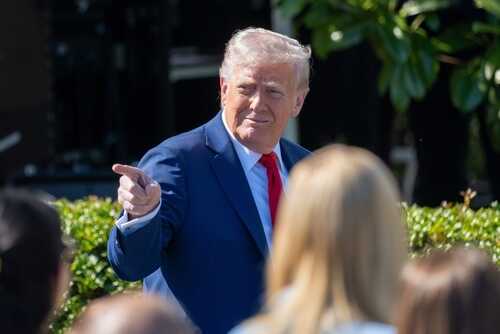
President Trump’s proposal for $2,000 “tariff dividend” checks for middle- and lower-income Americans, ostensibly funded by tariff revenues, is facing intense scrutiny. This analysis dives into the serious questions surrounding the plan, including the President’s claims of executive authority, the reality of a massive fiscal gap that undermines its feasibility, and existential legal challenges that threaten the entire funding mechanism. Furthermore, it highlights the “hidden costs” of tariffs that American families are already paying.
Story Highlights
- Trump proposes $2,000 “tariff dividend” checks to middle- and lower-income Americans using tariff revenues collected since February 2025
- The President suggests he may not need Congressional approval to issue checks, contradicting White House economic adviser Kevin Hassett’s December statement
- Tariff revenues of $159 billion collected through November 2025 fall drastically short of the estimated $279-606 billion cost to fund nationwide rebates
- Supreme Court challenges to tariff legality threaten the entire funding mechanism, with businesses like Costco seeking refunds
- Proposal targets 2026 midterm elections, while American households already bear approximately $1,200 in tariff costs per Joint Economic Committee analysis
Constitutional Questions Over Executive Authority
President Trump floated the idea that Congressional authorization may not be required to distribute $2,000 tariff rebate checks to American families, contradicting earlier statements from his own economic team. White House adviser Kevin Hassett confirmed on December 21, 2025, that Trump would likely send a proposal to Congress in 2026, acknowledging the legislative branch’s constitutional authority over federal spending. This contradiction raises serious questions about executive overreach and the proper separation of powers enshrined in the Constitution. Unlike pandemic stimulus payments authorized by Congress, these proposed checks would bypass the legislative process entirely, setting a dangerous precedent for unchecked executive spending authority.
🇺🇸 President Trump confirms Americans will receive a $2,000 tariff dividend payment in 2026. pic.twitter.com/Q52yu3cwhh
— Bitcoin Junkies (@BitcoinJunkies) December 19, 2025
Tariff Revenue Reality Exposes Fiscal Gap
The arithmetic behind Trump’s proposal reveals a significant funding shortfall that undermines its feasibility. Tariff collections from February through November 2025 totaled approximately $159 billion, with the Tax Foundation projecting $158.4 billion for all of 2025 and $207.5 billion for 2026. However, distributing $2,000 checks to middle- and lower-income Americans would cost between $279 billion and $606 billion, far exceeding available tariff revenues. This massive gap raises questions about whether the proposal represents genuine policy or political messaging ahead of the 2026 midterm elections. The Tax Foundation concluded such payments would be unaffordable and would not reduce the federal deficit as Trump claims, despite the administration pointing to a $600 billion year-over-year deficit reduction.
Legal Challenges Threaten Funding Mechanism
The entire tariff dividend proposal faces existential legal threats as multiple lawsuits challenge the validity of Trump’s 2025 tariffs imposed under the 1977 International Emergency Economic Powers Act. Major retailers including Costco filed suits in December 2025 seeking refunds if the Supreme Court strikes down the tariffs as unconstitutional. A ruling expected in early 2026 could eliminate the revenue stream entirely before any checks are issued. Senator Josh Hawley’s American Worker Rebate Act of 2025, which would have provided $600 to $2,400 in family rebates, remains stalled in Congress with no path forward. Meanwhile, the IRS and Treasury Department have made no announcements about implementing any rebate system, and eligibility criteria for “middle and lower income” recipients remain undefined.
Hidden Costs Already Burden American Families
While Trump promotes tariff dividends as benefiting working Americans, families are already paying the price for his protectionist trade policies. The Joint Economic Committee calculated that tariffs have cost American households approximately $1,198 on average, effectively functioning as a consumer tax passed through by importers. Goldman Sachs and Treasury Department data confirm these costs fall disproportionately on middle-income families the rebates purport to help. The proposal’s income thresholds remain vague, though analysts suggest eligibility may mirror pandemic stimulus limits around $75,000 for individuals and $150,000 for couples, varying significantly by state cost of living. California households face higher thresholds while Mississippi residents qualify at lower incomes, creating regional inequities.
Economists across the political spectrum warn that massive rebate checks could fuel inflation, echoing concerns many Republicans raised about 2021 pandemic stimulus spending. The combination of tariff-driven price increases on imported goods and potential inflationary pressure from government checks creates a double burden on household budgets. Manufacturing sectors may gain protection from foreign competition, but retail and import-dependent businesses face higher costs that ultimately reach consumers. The December 2025 $1,776 Warrior Dividend to 1.5 million service members, funded separately through housing accounts, demonstrates the administration can deliver targeted payments when proper funding mechanisms exist, making the tariff dividend’s fiscal uncertainty more glaring by comparison.
Watch the report: BREAKING: Trump’s $2,000 Stimulus Checks Coming… and he’s IGNORING Congress!
Sources:
$2,000 tariff dividend checks still possible in 2026 – Idaho Business Review
Fact check: Did Trump issue a $2,000 ‘tariff dividend’ and do you need to ‘act’?