
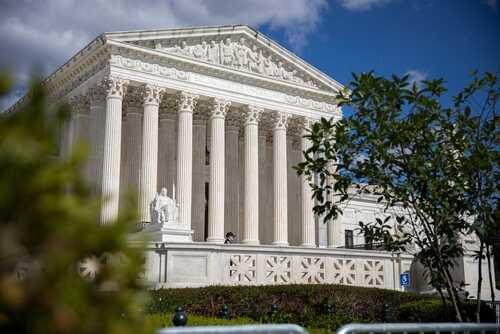
The Supreme Court is poised to decide whether President Donald Trump unlawfully used emergency powers to impose sweeping tariffs, a ruling that could redraw the boundaries of presidential trade authority.
At a Glance
- On August 29, 2025, the U.S. Court of Appeals for the Federal Circuit ruled that Trump’s use of the International Emergency Economic Powers Act (IEEPA) to impose tariffs was unlawful.
- The decision was stayed until October 14 to allow the government to appeal to the Supreme Court.
- The case centers on the “major questions doctrine,” which restricts executive action absent clear congressional approval.
- A ruling by the Supreme Court is expected in 2026 and could have sweeping constitutional and economic implications.
Executive Power Under the Microscope
The legal confrontation stems from Trump’s imposition of what were dubbed “Liberation Day” tariffs during his presidency. These duties targeted nations alleged to undermine U.S. economic security. The administration invoked IEEPA, a law historically reserved for genuine national security emergencies, to justify the move.
A lower court ruled in May 2025 that the tariffs exceeded the authority granted under IEEPA, stating that economic disputes do not constitute national emergencies in the legal sense. The Federal Circuit upheld that decision in late August, arguing that such actions fall under the purview of Congress unless clearly authorized—a core principle of the major questions doctrine.
Watch now: LIVE: US Court Strikes Down Trump Tariffs | IEEPA Explained
Defining the Limits of Presidential Trade Power
The case presents a critical test of executive authority in economic policy. The major questions doctrine, affirmed in recent Supreme Court rulings, requires Congress to speak clearly when authorizing the executive branch to take action on issues of vast political and economic importance.
If the Supreme Court affirms the Federal Circuit’s decision, it would limit the president’s capacity to use emergency powers for broad trade actions. Such a ruling would reassert legislative primacy in economic policymaking and potentially invalidate years of tariff-based enforcement actions taken without congressional oversight.
Alternatively, if the Court sides with the administration, future presidents could wield IEEPA or similar statutes to enact aggressive trade policies without legislative input. This outcome would strengthen the executive’s hand, particularly during times of geopolitical tension or economic disruption.
Business Fallout and Strategic Recalibration
For American businesses, especially small- and mid-sized importers, the uncertainty surrounding the legality of these tariffs has been disruptive. Companies affected by the duties have faced rising costs and reduced market access, prompting legal challenges and lobbying campaigns.
Meanwhile, the Biden administration has signaled that it will continue negotiating trade deals and may explore alternative legal pathways for enforcing tariffs. These include invoking Section 232 of the Trade Expansion Act or relying on the Tariff Act of 1930, both of which offer narrower but still potent tools for trade enforcement.
U.S. Trade Representative officials have indicated that the recent court decisions will not hinder ongoing trade diplomacy, suggesting a multi-pronged legal strategy is already in motion.
What to Expect from the Court
The Supreme Court is likely to hear oral arguments in the first half of 2026, with a decision expected by mid-year. The outcome could have significant fiscal consequences, including potential refund claims for improperly levied duties and the curtailment of emergency economic powers across the executive branch.
In constitutional terms, the ruling could redefine the boundary between legislative and executive functions in economic governance. A precedent that limits unilateral trade actions would recalibrate the balance of power in Washington, reaffirming the role of Congress in setting U.S. trade policy.
Until then, the tariffs remain in place—and the legal and economic uncertainty surrounding them continues to reverberate through boardrooms and diplomatic channels alike.
Sources
Wall Street Journal
Reuters
Axios
YouTube: LIVE: US Court Strikes Down Trump Tariffs | IEEPA Explained
Financial Times