
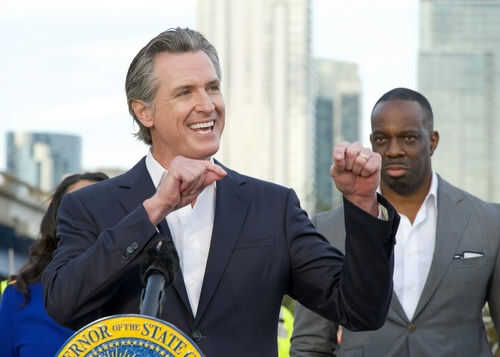
Gavin Newsom’s new “bestseller” appears to owe much of its momentum to a $1.56 million PAC-funded bulk buy that turned a political memoir into a fundraising giveaway.
Quick Take
- Newsom’s political action committee spent $1,561,875 to buy and distribute about 67,000 copies of his memoir to donors.
- The PAC’s purchases amounted to roughly two-thirds of reported sales since the book’s February 2026 release, raising questions about what “bestseller” really means.
- Newsom’s team says the strategy “more than paid for itself” through donations, while also claiming tens of thousands of “non-bulk” sales.
- The episode highlights a broader trust problem: politics, media incentives, and “elite” branding often blur into one another while voters feel squeezed.
PAC Money, Book Sales, and a “Bestseller” Label
California Gov. Gavin Newsom’s PAC, the Campaign for Democracy Committee, reported spending $1,561,875 to purchase and distribute about 67,000 copies of his memoir, Young Man in a Hurry: A Memoir of Discovery. Reporting indicated those PAC-procured copies represented about two-thirds of the book’s total sales since the February 2026 release, pegged at 97,400 copies at the time. The PAC listed the spending as “books at cost” through Porchlight Book Company.
The sales timeline matters because the donor giveaway started before the official publication date. Reports said the PAC began offering free copies to anyone who donated “any amount” starting in November 2025, then the book released in February 2026, followed by a March publicity push highlighting national reach and strong list placement. Those mechanics complicate the “bestseller” narrative, because sales charts can reflect volume without explaining how purchases were motivated.
How the Donor Giveaway Worked—and Why It Bothers People
The controversy is less about legality than about credibility. Campaign committees are allowed to spend money on political communications and supporter outreach, and the PAC’s expense was disclosed as a book purchase. The friction comes from the appearance of manufacturing demand: tying a “free” product to a donation can turn a book into a perk, not a reflection of readers choosing it in a normal marketplace. That distinction matters to voters who already doubt elite institutions.
Newsom’s team defended the approach as relationship-building and said the program generated more in donations than it cost, effectively subsidizing promotion with grassroots contributions. Supporters also emphasized the book’s broader performance, pointing to claims that tens of thousands of copies were sold outside bulk channels. Still, the available reporting leaves an unresolved question: how should the public weigh “organic” claims when the PAC-funded portion is so large and so central to early momentum?
Competing Claims: “Non-Bulk” Sales vs. Bulk-Buy Reality
By March 2026, Newsom’s team publicly touted over 91,000 “organic, non-bulk” sales, while local coverage also described the book topping a major bestseller list with nearly 100,000 copies sold. Yet other reporting emphasized the PAC’s 67,000-copy distribution as a dominant share of recorded sales. The mismatch may come down to timing, rounding, and definitions of “bulk,” but it highlights how easily political messaging can outrun what typical consumers assume those labels mean.
For conservatives frustrated with “woke” branding and institutional spin, the optics reinforce a familiar complaint: influential figures often use systems that seem designed to validate themselves. For liberals skeptical of big money and inequality, the same episode can look like a well-connected politician leveraging a fundraising machine to elevate personal status. Either way, the public’s frustration is predictable because the gap between marketing and reality is exactly where trust breaks down.
Why This Matters Beyond One Governor’s Memoir
Political books have long been a tool for building national profiles, and controversies over bulk purchases are not new. What stands out here is the straightforwardness of the transaction: a political committee spent seven figures, then distributed copies directly to donors as an incentive tied to contributions. Even if no royalties were paid to Newsom, the book still functioned as a credibility asset—one that can translate into media bookings, donor attention, and national speculation about future ambitions.
Want to Know How Gavin Newsom Sold So Many Books? (Hint: It Wasn't Because Anyone Wanted to Read It) https://t.co/25NmKXue9P
— 1TahoeGirl (@1TahoeGirl) April 17, 2026
In a country where many voters—right and left—say the federal government is failing ordinary people, stories like this land with extra force. They look like a closed loop of influence: fundraising generates visibility, visibility generates more fundraising, and the “bestseller” label becomes another piece of political armor. The available reporting does not establish wrongdoing, but it does show how modern politics can turn cultural markers of success into engineered outcomes rather than earned trust.
Sources:
Gavin Newsom’s PAC Spent $1.5 Million To Buy Copies of His Book