

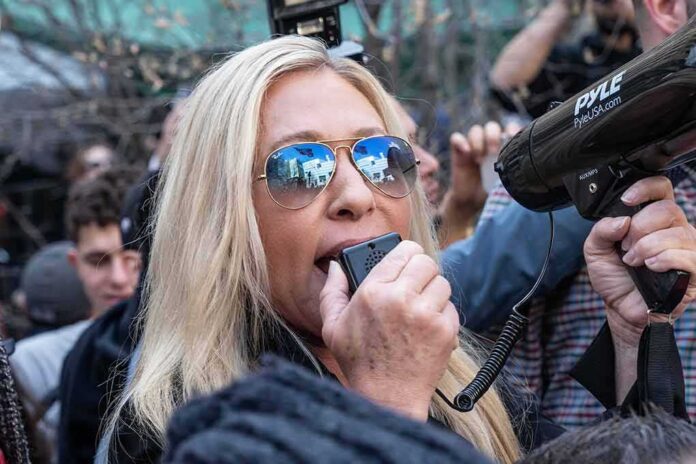
Rep. Marjorie Taylor Greene publicly blasted President Trump’s 2020 fraud claims by asking why no result-changing prosecutions ever followed.
Story Snapshot
- Greene asked why, with control of the Justice Department, no 2020 fraud case changed results.
- A federal indictment says Trump pushed claims of outcome-changing fraud as knowingly false allegations.
- Courts in Michigan and Nevada rejected evidence of widespread fraud after review.
- An Associated Press review found too few fraud cases to alter the 2020 outcome.
Greene’s Post Challenges Prosecution Record
On November 9, 2026, Rep. Marjorie Taylor Greene posted that people should ask why there have been no prosecutions proving 2020 election fraud changed the result. She wrote that anyone buying “bullshit” should look at the record and ask whether anyone was prosecuted during the period when President Trump led the Justice Department. Her point targeted the gap between sweeping claims and courtroom outcomes, not isolated, small-bore cases.
Greene’s broad phrasing that “no one” was prosecuted can be read too literally. Some individuals were charged for discrete violations like double voting or voting for a relative. But those scattered cases were few and did not approach the scale needed to flip states. Her core challenge hit a narrower issue: no prosecution has established fraud big enough to change the 2020 result.
What Courts and Case Files Actually Show
Michigan’s high court brushed aside a key 2020 lawsuit after lower courts found the offered fraud claims not credible. The order left in place findings that affidavits and theories failed basic evidentiary tests. Judges require documents, data, and witnesses who withstand cross-checks. That bar was not met in these filings, so the cases did not move forward toward remedies that could alter tallies or procedures for certification.
A Nevada court reached a similar bottom line after reviewing claims lodged by Trump allies. The judge wrote that the contestants did not provide credible and relevant evidence to prove that illegal votes were counted or legal votes were tossed, under any standard of proof. That is a strong statement. It says the evidence did not work even at a lower bar, much less the high bar needed to undo a statewide election.
Official Reviews Undercut “Outcome-Changing” Claims
A nationwide review by the Associated Press counted fewer than 475 potential fraud cases in the six contested states a year after the election. The review concluded that the total was far too small to tip the race. The report also described a handful of charges and many referrals that did not lead to prosecution. The picture that emerges is not “zero problems,” but “not nearly enough to change who won” in any state that decided the Electoral College.
Attorney General William Barr said in December 2020 that the Department of Justice had not seen fraud on a scale that could change the outcome. That statement came from the nation’s top federal law enforcement official at the time. It aligned with what courts later wrote and what election officials reported during recounts and audits. Barr’s comment does not claim perfect elections; it addresses the key question of scale and effect.
How Greene’s Shot Lands With Conservatives
Conservatives want clean rolls, voter ID, and rules that stop ballot harvesting. They also want proof that holds up in court. Greene’s post presses for evidence that wins cases, not clicks. That demand fits core values: truth, the rule of law, and results. The record shows courts rejected the big fraud claims, and reviews found too little misconduct to flip states. That is why her question about prosecutions resonates even when some small cases did occur.
A federal indictment filed in 2023 states prosecutors’ theory that President Trump and others pushed knowingly false, outcome-changing claims. An indictment is not a verdict, but it documents the government’s view and evidence offers. It reflects how officials and courts have treated these assertions since 2020: they looked, they tested, and they did not find proof that could change certified results. That context makes Greene’s challenge sharper in 2026.
The Path Forward: Secure Elections Without Spin
States can tighten voter rolls, require photo ID, and track mail ballots with clear chain of custody. Counties can post ballot images, audit trails, and batch reports online for rapid public checks. Prosecutors can publish referral and case dashboards by county and offense. These steps protect the vote and rebuild trust without feeding confusion between small violations and claims of a stolen election. Transparency and clear rules serve every voter and every lawful ballot.
Sources:
mediaite.com, news.meaww.com, justice.gov, apnews.com, politifact.com, statesunited.org