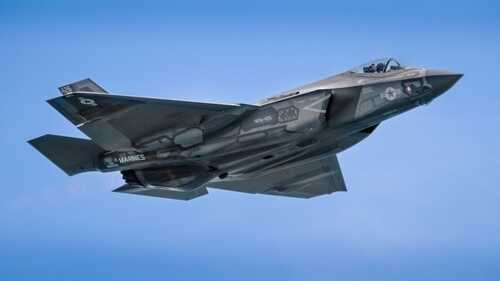
China’s new J-35A stealth fighter jet has surfaced in startling photos, fueling fears that Beijing’s military might soon directly rival the U.S. F-35 fleet.
At a Glance
- Photos emerge showing China’s J-35A stealth fighter in test flights.
- Analysts say the jet closely resembles America’s F-35 fighter.
- The J-35A could soon operate from Chinese aircraft carriers.
- China’s rapid military advancement alarms U.S. defense officials.
- U.S. experts worry China’s stealth tech may challenge American air superiority.
The Stealth Fighter Sparking Global Alarm
Images obtained by Newsweek reveal China’s J-35A stealth fighter jet in new flight tests, triggering widespread concern at the Pentagon and among defense analysts worldwide. The jet, bearing an uncanny resemblance to America’s renowned F-35 Lightning II, was spotted soaring over undisclosed locations, prompting speculation that China’s military tech may have rapidly closed the gap with U.S. air supremacy.
Military analysts noted the striking similarity in design—specifically the fighter’s stealth-optimized features and aerodynamic profile. “This isn’t just imitation,” warned a senior defense researcher quoted by Newsweek. “It signals China’s growing confidence and capability in advanced stealth technology.”
Watch a report: China Unveils J-35A Stealth Fighter in Bid to Match U.S.
U.S. Air Dominance Under Siege?
The stealthy J-35A, developed by China’s Shenyang Aircraft Corporation, first appeared in blurry satellite imagery a few years ago but now seems ready for full-scale deployment. Reports indicate the jet is designed to operate from China’s newest aircraft carriers—platforms that are themselves becoming increasingly advanced, threatening to alter the naval balance of power in the Pacific.
U.S. Navy Admiral John Aquilino recently warned that China’s rapidly evolving capabilities, including stealth technology, hypersonic missiles, and modern aircraft carriers, pose an unprecedented challenge to American strategic dominance. His remarks, delivered during a Senate Armed Services Committee hearing, underscored growing anxiety in Washington that the U.S. might soon face genuine air-to-air competition—a scenario not seen since the Cold War.
Stolen Tech or Strategic Breakthrough?
While the Pentagon remains tight-lipped on specifics, defense experts speculate that China’s J-35A may have benefited from illicitly acquired U.S. technologies. In recent years, Chinese cyber-espionage has repeatedly targeted American defense contractors, with hacks reportedly netting classified details on stealth technologies. A Department of Justice report explicitly accuses Chinese agents of stealing sensitive data, including blueprints related to stealth aircraft.
Regardless of how China obtained these advanced capabilities, the emergence of the J-35A could have profound strategic implications. Military strategists worry that Beijing’s accelerated production and deployment of cutting-edge stealth jets could diminish the effectiveness of American military deterrence in the Pacific, potentially emboldening China to press territorial claims more aggressively in Taiwan and beyond.
As these alarming photos spread across military circles, one question looms large: Has the era of unchallenged American air dominance finally come to an end?