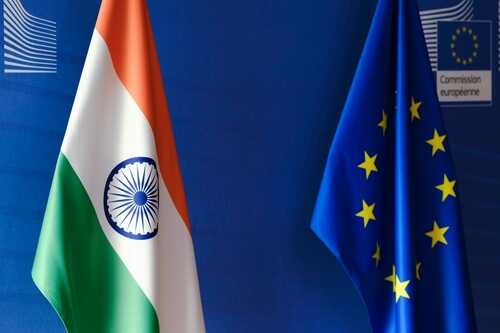
India and the European Union have successfully concluded a landmark Free Trade Agreement (FTA) after two decades of complex negotiations. The deal, which aims to eliminate tariffs on over 96% of goods, strategically positions both partners against global uncertainties, particularly counteracting protectionist policies from the United States. Projected to boost bilateral trade significantly and strengthen supply chains, the FTA represents a major pivot in global commerce, focusing on stability and strategic diversification away from unpredictable American markets.
Story Highlights
- India-EU Free Trade Agreement concluded after 20 years, eliminating tariffs on over 96% of goods to counter U.S. protectionism.
- Deal projected to boost bilateral trade by 41-65% and double EU exports to India by 2032, creating jobs and strengthening supply chains.
- Strategic timing follows EU’s withdrawal of GSP benefits for India, providing tariff certainty amid Trump-era trade disruptions.
- Agreement leaves sensitive sectors like agriculture and intellectual property unresolved, emphasizing stability over transformation.
- Ratification expected by 2027-2028, with India gaining access to $750 billion electronics market while EU secures pharma and machinery exports.
Two Decades of Negotiations Conclude Amid Global Trade Shifts
India and the European Union successfully concluded Free Trade Agreement negotiations during European Commission President Ursula von der Leyen’s Republic Day visit in January 2026. The agreement targets elimination or reduction of tariffs on 96.6% of EU goods exports to India and covers 96% of EU lines and 90% of Indian exports. Negotiations originated approximately 20 years ago, experiencing lengthy pauses due to complexities surrounding tariffs, non-tariff barriers, and market access disputes similar to the failed U.S.-EU Transatlantic Trade and Investment Partnership.
BREAKING: Details of the historic trade deal between India and the EU have emerged:
1. Eliminates tariffs on ~90% of goods trade between EU and India
2. Set to double EU goods exports to India by 2032
3. Tariffs on cars from EU to India cut from 110% to 10%
4. Tariffs on… pic.twitter.com/w3pNvZjaiW
— The Kobeissi Letter (@KobeissiLetter) January 27, 2026
Strategic Diversification Beyond American Markets
The FTA represents a calculated response to global supply chain vulnerabilities and protectionist policies, though specialists caution against overhyping Trump’s direct influence. The Atlantic Council notes the agreement provides predictability and replaces India’s lost EU Generalized System of Preferences benefits rather than creating entirely new advantages. The deal’s acceleration began during the Biden administration, building on post-2023 G20 initiatives including the India-Middle East-Europe Corridor and EU’s Global Gateway program. This strategic partnership reduces dependence on unpredictable American trade policies while countering China’s manufacturing dominance.
Economic Impact and Sector Winners
Indian manufacturers gain access to Europe’s $750 billion electronics market, while pharmaceutical and chemical exports are projected to surge significantly. The Kiel Institute estimates bilateral trade will increase between 41-65%, with EU goods exports to India doubling by 2032. Auto parts manufacturers benefit from reduced barriers, though luxury vehicle prices remain unchanged. European exporters in machinery, aerospace, and green technology sectors secure preferential access to India’s rapidly expanding market. The agreement also establishes frameworks for technology transfer in semiconductors, artificial intelligence, and clean energy, strengthening both economies’ positions in global value chains.
Deliberate Pace Reflects Conservative Approach
Anand Mahindra of Mahindra Group praised the “make haste slowly” philosophy underlying India’s negotiation strategy, emphasizing measured progress over rushed commitments. The agreement deliberately postpones contentious issues including agricultural market access, intellectual property protections, and carbon border adjustment mechanisms for future negotiations. This pragmatic approach protects sensitive domestic sectors while establishing tariff certainty for manufacturers and exporters. The EU Council and Parliament must ratify the agreement, requiring qualified majorities that balance 27 member states’ competing interests, particularly regarding farmer protections and intellectual property standards.
Implementation Timeline and Remaining Challenges
Technical reviews and domestic ratification processes are underway, with full implementation expected between 2027-2028. The agreement awaits approval from both the EU Council and Indian parliament, with follow-up negotiations scheduled on investment protection, geographical indications, and remaining agricultural concerns. Leaders committed to a Trade and Technology Council meeting in Brussels during 2026 to address innovation hubs and digital public infrastructure collaboration. While the deal provides stability against American tariff volatility, it won’t immediately transform supply chains or resolve all market access barriers. The timing coincides with EU’s GSP withdrawal for India in early 2026, shifting textile competitiveness dynamics and creating urgency for alternative preferential arrangements.
Watch the report: India-EU Seal Historic Trade Deal Covering 99% of Exports | Vantage on Firstpost
Sources:
- India-EU Trade Deal is a ‘Make Haste Slowly’ Moment, Says Anand Mahindra – Economic Times
- The India-EU Trade Deal is Worth Watching, But Not Overhyping – Atlantic Council
- European Commission Press Release on India-EU Trade Agreement