

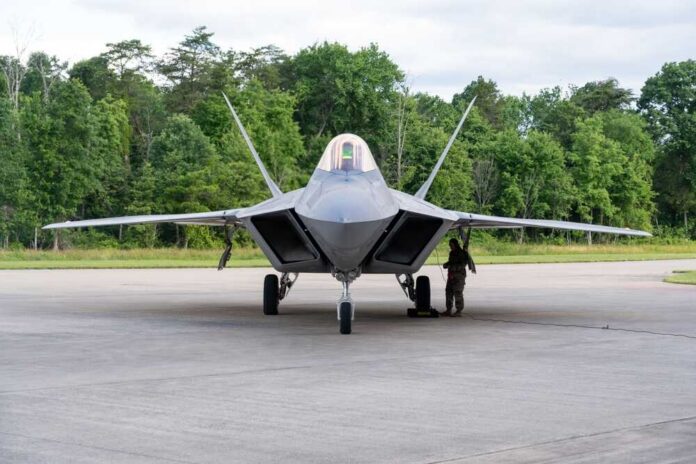
After years of budget “savings” and shifting priorities, the U.S. is staring at a hard reality: America can’t rebuild the F-22 fleet it once planned, and the next-generation replacement is now slipping into the mid-2030s.
Quick Take
- The Air Force originally planned for 750 F-22 Raptors but ended up with 189, a gap that analysts say cannot be reversed because production ended.
- A congressional warning in March 2026 said the F-47 and the Navy’s F/A-XX could be delayed to the mid-2030s, extending the timeline for a true successor.
- To cover the gap, the Air Force is testing “F-22 2.0” upgrades like stealth external fuel tanks and sensor improvements aimed at Indo-Pacific distances.
- Claims that China already has 6th-generation fighters “in the air” remain uncorroborated in the provided reporting, but China’s overall fighter modernization continues.
Why the F-22 Shortfall Still Shapes U.S. Power in 2026
The U.S. Air Force’s F-22 Raptor is widely treated as the premier air-superiority fighter of its generation, but the fleet’s size remains the central vulnerability. U.S. planning in the early 1990s reportedly envisioned 750 F-22s, yet production ended at 189 aircraft after a 2009 decision to cap the line amid cost pressures and changing priorities. Once specialized tooling and supply chains disappear, restarting production becomes more theory than plan.
In practical terms, fleet size becomes strategy. A limited number of aircraft constrains how many combat-coded jets can be deployed at once, how many can be held in reserve, and how quickly the force can absorb losses or maintenance downtime. For conservative voters tired of open-ended foreign commitments, this creates an uncomfortable bind: under-building deterrence can invite crises, but overreacting to crises can drag the country into wars that never seem to end.
F-47 Delays and the “What Do We Do in the Meantime?” Problem
A March 2026 disclosure from a senior member of Congress warned that the Air Force’s F-47 and the Navy’s F/A-XX may not arrive until the mid-2030s, described as at least five years behind schedule. That warning matters because the successor program is supposed to carry the air-superiority mission forward as threats modernize. If the timeline slips, the Air Force must keep today’s fleet credible longer, with fewer options to surge.
The same reporting raised a second issue: planned F-47 procurement numbers that critics argue could be too small for sustained high-end operations. That critique echoes an older lesson conservatives have watched play out across multiple administrations—Washington often makes promises based on best-case schedules, then asks taxpayers to fund emergency “bridges” and patches when reality hits. The fiscal and readiness costs tend to arrive after the political decision-makers have moved on.
“F-22 2.0” Upgrades Target the Indo-Pacific Range Problem
With the replacement timeline uncertain, the Air Force is leaning harder on modernization to extend the F-22’s usefulness. Reporting in 2026 described flight testing that showcased advanced developments, including stealthy external fuel tanks and sensor pods, aimed at long-range missions in contested airspace. Analysts have repeatedly flagged the F-22’s “notoriously short range” as a major issue for Indo-Pacific geography, where distance and basing constraints shape whether airpower arrives early or late.
These upgrades are not cosmetic. Stealth external tanks are intended to add endurance without turning the aircraft into an easy target in high-threat environments, while improved sensors can help find and track aircraft designed to be harder to detect. The concept is straightforward: if the U.S. cannot rapidly field a new fighter in large numbers, it must squeeze more range, persistence, and awareness out of the aircraft it already has, while accepting that upgrades do not equal a new production run.
China’s Fighter Push: What’s Confirmed, What’s Still Unclear
Some commentary claims China already has 6th-generation fighters “in the air,” but the provided research also notes that those claims lack corroboration in other cited outlets. What is clearer is that China continues expanding and improving its fighter force, including the J-20, and building the broader anti-access environment that complicates U.S. operations. For readers focused on national sovereignty and security, the key takeaway is less about hype and more about timelines and capacity.
That distinction matters because threat inflation can be used to justify policies conservatives often distrust: blank-check spending, rushed procurement, and “emergency” authorities that sidestep normal oversight. At the same time, pretending the competition is imaginary invites the opposite failure—strategic complacency followed by panic. The most defensible position, based on available reporting, is to treat China’s modernization as real while separating verified developments from attention-grabbing claims.
What This Means for Taxpayers, Readiness, and Constitutional Accountability
The Air Force’s current predicament is partly a story of capability and partly a story of governance. The U.S. spent heavily to field an elite air-dominance fighter, then curtailed production at a level critics say created a permanent numbers deficit. Now, with a successor slipping, the country is paying again to stretch the aircraft through upgrades and sustainment. That cycle—build, cut, patch, delay—should raise hard questions about procurement discipline and congressional oversight.
For a Trump-era conservative coalition that is increasingly skeptical of foreign entanglements, the policy challenge is balancing deterrence with restraint. Strong airpower can prevent wars by making them unattractive to adversaries, but weak planning can also trap America into “must-act” moments with fewer choices. The constitutional bottom line is accountability: major defense decisions should be debated openly, funded transparently, and aligned with clear national interests—rather than sold through wishful schedules or crisis-driven politics.
Sources:
https://www.popularmechanics.com/military/weapons/a21694/f-22-f-35-war-future-china/
https://nationalinterest.org/blog/buzz/americas-f-22-raptors-finally-getting-upgrade-hk-032526
https://simpleflying.com/how-f-22-raptor-stacks-up-chengdu-j-20-2026/