
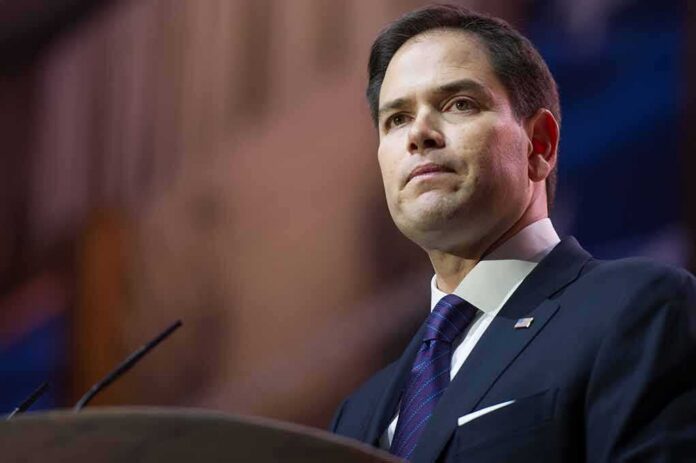
Secretary of State Marco Rubio told allies the United States is pausing new strikes on Iran while tightening sanctions, but will hit back hard if Tehran attacks first.
Story Highlights
- Rubio signaled a pause on initiating new strikes, shifting focus to sanctions pressure.
- Military action remains on the table if Iran strikes U.S. forces or partners first.
- Diplomacy around the Strait of Hormuz has advanced during the recent pause.
- Analysts say pressure works best when paired with a credible threat of force.
Rubio’s Message to Allies: Pause Strikes, Tighten the Squeeze
Axios reported that Rubio told several foreign counterparts the United States is not expected to start new strikes on Iran “for the time being,” and that Washington will raise economic and diplomatic pressure instead. A United States official said Rubio did not rule out future strikes if Iran attacks first, making clear this is a pause, not a retreat. This approach aims to hold Iran in check while giving talks room, without giving up America’s leverage or its red lines.
NPR reported that the United States and Iran paused airstrikes as diplomacy moved forward, including talks to reopen safe shipping through the Strait of Hormuz. The pause followed nearly two weeks of U.S. strikes and Iranian retaliation. The window allowed mediators to work, while U.S. forces remained on alert. This mix of pressure and restraint matches a long pattern in this standoff, where pauses are used to test if Iran will shift its behavior without more force.
Sanctions First, Force if Needed: The Strategy and Its Logic
Researchers at Brandeis University describe “maximum pressure” as a strategy that can push Iran to the table if it keeps a real threat of escalation in reserve. Rubio’s stance mirrors that logic: tighten sanctions and maritime pressure, but keep the hammer ready if Iran strikes. That balance speaks to conservative principles: peace through strength, clear lines, and no blank checks for a hostile regime that funds terror and threatens our allies. It also avoids open-ended wars that cost American lives.
Reuters has chronicled the recurring cycle: short bursts of fighting, pauses to test diplomacy, then renewed pressure when Tehran hedges. This is not confusion; it is coercive diplomacy. It seeks results without trading away deterrence. The United States signals readiness to defend troops and ships while pressing Iran’s economy and access to hard currency. That pressure targets the regime who drives aggression, not American families who already pay high prices because of global shocks.
What This Means for American Security, Energy, and the Region
Rubio’s message supports three aims: protect U.S. forces, keep sea lanes open, and force Iran toward limits on its aggression. NPR’s reporting on talks through Oman suggests a path to ease shipping risks around Hormuz, which can help steady fuel markets if progress holds. A pause also lets U.S. commanders reset and refine targeting, while allied navies coordinate patrols. If Iran fires first, the policy allows rapid, lawful self-defense with clear public backing and allied support.
Conservatives should watch two markers in the days ahead. First, does shipping traffic and insurance risk around Hormuz improve as talks continue? Second, do sanctions actions tighten where it matters, including energy revenue and funds for Iran’s proxies? The administration says yes to both tracks: pressure and deterrence. Rubio’s line keeps faith with peace through strength while avoiding a drawn-out ground war. If Tehran tests the pause, the United States retains every option to respond.
Sources:
facebook.com, bloomberg.com, politico.com, npr.org