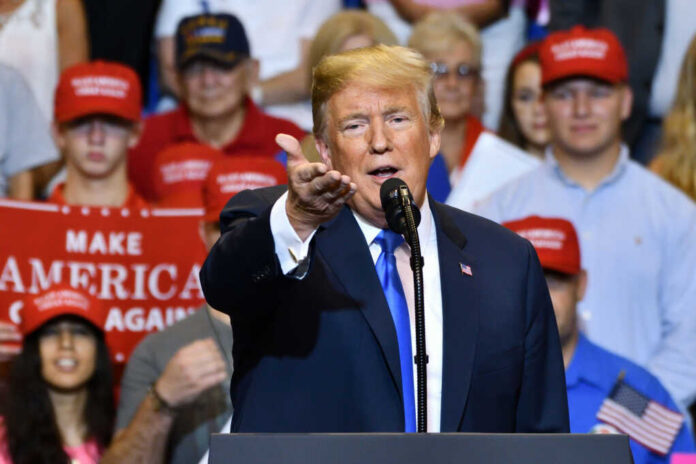
President Donald Trump is again threatening to strip broadcast licenses from ABC and NBC after they did not carry his primetime speech live.
Quick Take
- Trump said ABC and NBC should lose their licenses after skipping his address live.
- He claimed the networks gave him unfair coverage and hid the speech’s message.
- He has made similar threats before against major television outlets.
- Legal experts say the Federal Communications Commission cannot revoke a license just for critical news coverage.
Trump Targets Networks Over Live Coverage Decision
President Donald Trump lashed out Thursday after ABC and NBC chose not to air his election-focused speech live. Trump said the networks knew what the speech was about and still refused to interrupt their regular programming. He then said that choice should lead to a loss of their broadcast licenses. His remarks fit a pattern he has used for years against outlets that report aggressively on him.
The dispute centered on a speech Trump used to push claims about election integrity and media bias. According to Reuters and other reports, Trump accused the networks of acting like partisan players and said they were using public airwaves without paying for them. He also repeated his view that their coverage is overwhelmingly negative. NPR reported that he had recently called ABC and NBC “two of worst and biased networks history.”
Why the Threat Matters
The Federal Communications Commission licenses local broadcast stations, but legal experts say those licenses cannot be pulled simply because a president dislikes coverage. Brookings said the agency does not have authority to revoke a license based on a particular newscast. CNBC explained that a revocation would affect local station owners and would require a finding that a station failed to serve the public interest, not just that it angered the White House.
That legal reality has not stopped Trump from using the same threat again and again. CNN said he has called for broadcast licenses to be revoked on at least 15 occasions over the past two years. Reuters reported that he renewed the attack in November when he demanded ABC’s license be revoked after a reporter asked him about Jeffrey Epstein files. The latest fight shows how quickly a media dispute can turn into a test of First Amendment limits.
What the Broadcast Fight Signals
The decision by ABC and NBC to skip the live feed was itself unusual, but it was not unprecedented. Reuters noted that major networks have declined to air some presidential speeches live in past election cycles. Still, Trump made the refusal part of the story and used it to argue that the networks were suppressing his message. For viewers who want straightforward coverage, the episode shows how divided the media has become.
The deeper issue is not just one speech. It is the growing clash between a president who wants hostile coverage punished and a press corps that still has broad freedom to ignore him, criticize him, and decide what to broadcast. The reporting shows Trump is pressing the same argument in public, but the law still stands in his way. For conservative readers tired of media double standards, the fight may feel familiar. It is another round in a long war over who controls the narrative.
Sources:
mediaite.com, reuters.com, npr.org, cnbc.com, nbcnews.com, time.com, youtube.com, internazionale.it, thedailybeast.com