
A predawn inferno at a UK air base hosting U.S. bombers for Iran operations lit up the sky—and instantly tested whether allied military hubs are truly secure when tensions are high.
Story Snapshot
- Fire crews responded early Sunday, April 26, to a major blaze at RAF Fairford in Gloucestershire, a base used for U.S. bomber deployments.
- Officials said the fire was contained to a single-storey, disused or storage-related building; the roof collapsed, but there were no reported injuries.
- Authorities reported early indications the cause was accidental, even as online speculation surged due to the base’s link to the Iran conflict.
- Reports noted protests outside the base the day before, adding political heat to an already volatile information environment.
What Happened at RAF Fairford—and What Officials Confirmed
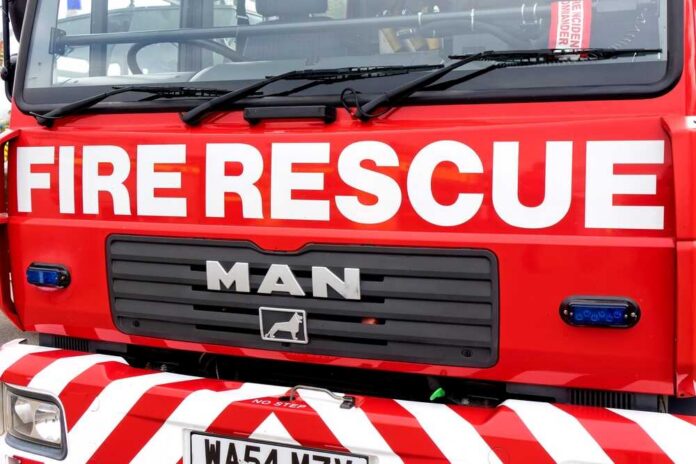
Gloucestershire Fire and Rescue Service received an emergency call in the early hours of Sunday, April 26, after a large fire broke out “inside the wire” at RAF Fairford. Multiple reports described thick smoke, visible flames, and a roof collapse as crews worked to bring the situation under control. Officials stated there were no casualties and no confirmed damage to aircraft, a key detail given the base’s role supporting U.S. bomber activity tied to the Iran conflict.
UK Ministry of Defence statements and subsequent media reporting framed the incident as limited to a non-operational building—often described as an old commissary or industrial storage structure—rather than a hangar or flightline facility. Residents in nearby areas were reportedly advised to close windows and doors as a precaution due to smoke. By later in the morning, the fire was described as contained, with crews remaining on site to prevent flare-ups.
The Cause: “Early Indications” Point to Accident, Investigation Continues
Fire officials emphasized that early information suggested an accidental cause, while also acknowledging that investigations were still underway. That phrasing matters: “early indications” can calm public fears without pre-judging a final determination, especially when the incident occurs at a strategically sensitive site. At minimum, the official line undercuts the more sensational online claims that quickly spread—claims that, based on available reporting, have not been supported with evidence.
For many Americans, the credibility gap is the story beneath the story. In an era when government institutions are often viewed as self-protective and slow to disclose uncomfortable facts, people naturally ask whether key details are being minimized. In this case, the reporting available so far offers verifiable basics—time of call, location, building type, no injuries, no aircraft damage—but provides limited technical detail about ignition source, security footage, or exact remediation steps.
Why RAF Fairford Matters During the Iran Conflict
RAF Fairford is not an obscure outpost. Reporting describes it as a long-used hub for U.S. strategic bomber deployments dating back decades, including aircraft such as the B-2 Spirit and B-52 Stratofortress. In the 2026 conflict environment, the base’s association with long-range “defensive” missions connected to Iran makes it a magnet for both legitimate public interest and adversarial attention. Even a fire in a disused building becomes headline news when geopolitics are combustible.
From a conservative perspective focused on national security and readiness, the key takeaway is operational resilience: the incident appears not to have disrupted bomber operations, but it highlights how quickly a single event can trigger uncertainty. The public learned about smoke plumes and collapsed roofing quickly; it learned far less about continuity planning, perimeter security posture, and how commanders ensure that a localized incident cannot cascade into broader mission risk.
Protests, Online Narratives, and the Trust Problem in 2026
Several reports pointed to protests outside the base on April 25, involving roughly 200 demonstrators opposing the use of UK territory in U.S.-linked Iran operations. That timing became rocket fuel for social media speculation, even though officials have said the initial indications suggest an accident. This is where politics and information warfare intersect: protest activity does not prove wrongdoing, but it can shape public assumptions before investigators finish basic fact-finding.
The broader pattern is familiar to voters on both the right and the left: institutions ask the public to wait for conclusions, while unofficial narratives fill the gap instantly. Conservatives may focus on the security implications and the cost of constant crisis management; liberals may focus on the morality of overseas operations and foreign basing. What both sides increasingly share is distrust—especially when official communications provide only partial granularity. At this stage, the strongest claim supported by the reporting is narrow: a serious fire happened, was contained, and is being investigated.
Sources:
VIDEO: Fire erupts at UK air base used by US bombers
RAF Fairford fire: Huge blaze at RAF base used by US Air Force amid Iran war, Gloucestershire