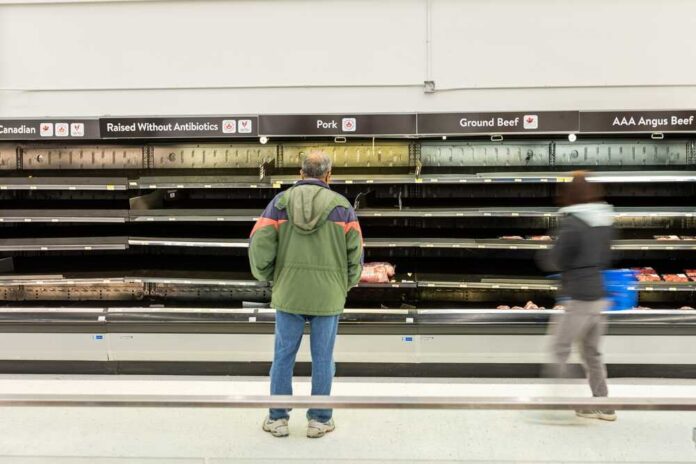
Secret UK government planning reveals British families could face empty supermarket shelves and meat shortages by summer as Middle East conflict threatens a critical industrial gas needed to keep food supplies flowing.
Story Snapshot
- UK government conducted classified “Exercise Turnstone” modeling worst-case food shortages for June 2026 if Strait of Hormuz remains blocked
- Carbon dioxide supply could plummet to just 18 percent of current levels, threatening meat production, healthcare, and food preservation
- Government already restarted bioethanol plant and preparing emergency legislation to force factories to prioritize CO2 production
- Healthcare sector prioritized as CO2 shortage risks blood supplies and vaccines; meat industry most vulnerable with no surplus stock
Hidden Contingency Planning Exposes Food Security Vulnerability
Senior officials from Downing Street, the Treasury, and the Ministry of Defence conducted confidential planning exercises examining impacts of prolonged Strait of Hormuz closure. The assessment, codenamed “Exercise Turnstone,” was coordinated through Cobra, the government’s emergency response committee. Officials modeled a reasonable worst-case scenario set in June 2026, assuming the key shipping route remains blocked with no lasting peace deal. The timing coincides with the FIFA World Cup beginning June 11, raising concerns about public confidence during a high-profile international event when disruption would be most visible.
Carbon Dioxide Crisis Threatens Meat Production and Healthcare
The primary concern centers on carbon dioxide supply disruptions essential for food preservation, animal processing, and meat production. A major UK production site breakdown combined with high gas prices hitting European ammonia and fertiliser production could reduce CO2 supplies to just 18 percent of current levels. The meat sector faces particular vulnerability, relying on CO2 for slaughter of almost all pigs and more than two-thirds of chickens. Agriculture, hospitality, and brewing sectors would be hit first, but healthcare has been identified as top priority, with warnings that CO2 collapse could pose life-threatening risks to blood supplies and vaccines.
Government Mobilizes Emergency Powers and Industry Controls
The government already restarted the Ensus bioethanol plant in Teesside for three months to boost CO2 supply. Government lawyers have been asked to prepare for potential use of the Civil Contingencies Act, granting ministers sweeping emergency powers. Plans discussed include forcing factories to prioritize CO2 production, with emergency legislation potentially passed within days. Competition rules could be relaxed to direct limited supplies toward critical sectors. Compensation for firms required to halt normal operations could run into tens of millions of pounds, illustrating the scale of potential government intervention in market operations.
Economic Turmoil and Inflationary Pressure Loom
Escalating tensions in the Iran conflict have already caused energy and fertiliser costs to increase, affecting food production across Europe. The British Retail Consortium warned that escalating tensions are likely to cause economic turmoil and inflationary pressure throughout the economy. The International Monetary Fund cautioned that prolonged conflict could lead to economic turmoil worldwide. While major retailers including Tesco report no immediate accessibility issues and industry leaders state supply chains remain stable, experts suggest food prices will likely increase soon even if supplies remain secure. The interconnected nature of European energy and fertiliser markets means disruption affects multiple countries’ CO2 production simultaneously.
Government Emphasizes Preparedness Over Prediction
A government spokesman stated the administration took decisive action last month to shore up critical CO2 supplies and continues working closely with business groups to tackle impacts of Middle East events. Officials emphasize the planning represents contingency preparation rather than prediction of upcoming situations. However, the assessment reveals serious concern about economic impacts, public confidence erosion, and healthcare risks if worst-case scenarios materialize. Consumers could see reduced choice on supermarket shelves rather than widespread shortages, though the meat sector has little surplus stock and government reserves would not provide long-term solutions. This planning underscores how geopolitical conflicts in distant regions can cascade into domestic crises affecting ordinary citizens’ daily lives.
Sources:
UK Prepares for Possible Food Shortages Amid Strait of Hormuz Crisis
Britain Preparing for Food Shortages as Iran War Bites
UK Prepares for Food Shortages in Worst-Case Scenario as Iran War Continues
Iran War Hormuz: UK Supermarkets Food Shortages Chicken