
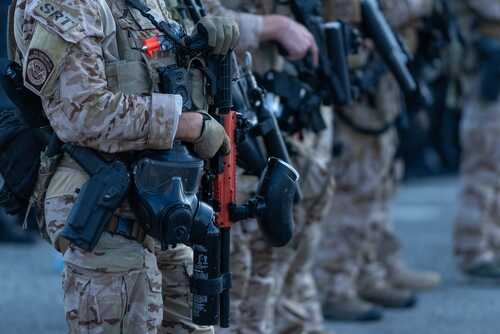
A landmark ruling from the U.S. Supreme Court has blocked President Donald Trump’s attempt to deploy National Guard troops to Illinois, marking a significant moment in the ongoing tension between federal authority and state sovereignty. The Court’s 6–3 decision upheld an injunction, preventing the deployment aimed at protecting federal ICE facilities in Chicago. This ruling is seen as a victory for states’ rights advocates and a check on presidential power, especially in domestic military operations.
Story Highlights
- The Supreme Court ruled 6–3 against Trump’s National Guard deployment to Illinois.
- The decision emphasized constitutional limits on federal use of state-controlled forces.
- Illinois officials successfully argued the move exceeded Trump’s authority.
- The ruling marks a rare loss for Trump at a conservative-majority Court.
Supreme Court Blocks Trump’s Deployment
A landmark ruling from the U.S. Supreme Court has blocked President Donald Trump’s attempt to deploy National Guard troops to Illinois, marking a significant moment in the ongoing tension between federal authority and state sovereignty. The Court’s 6–3 decision upheld the Seventh Circuit Court of Appeals’ injunction, preventing the deployment aimed at protecting federal ICE facilities in Chicago. Illinois officials had argued that the move violated the Constitution’s federalism principles and exceeded Trump’s authority under the Insurrection Act.
This decision, handed down on December 23, 2025, underscores a critical interpretation of the Insurrection Act and related statutes, which typically require significant justification for federal troop deployment over a state’s objections. The ruling is seen as a victory for states’ rights advocates and a check on presidential power, especially in domestic military operations.
Conservative Court’s Unusual Ruling
The Supreme Court’s conservative majority has frequently been perceived as supportive of Trump’s policies, yet this decision presents a notable deviation. Chief Justice Roberts, along with Justices Barrett and Kavanaugh, joined the liberal bloc in opposing the deployment. This alignment highlights the court’s commitment to constitutional federalism and the limits of executive power. The decision suggests that concerns over federal overreach and the protection of state sovereignty can transcend typical partisan lines, reflecting broader constitutional principles.
While the Trump administration framed the deployment as necessary for maintaining order and protecting federal assets, Illinois successfully argued that the situation did not meet the statutory requirements for such federal action. The state’s leadership maintained that there was no insurrection or breakdown of law enforcement capacity that justified overriding state control of its National Guard.
🚨 LMAO! The Democrat lawfare against President Trump may now BACKFIRE, resulting in MARINES being sent into Chicago instead of National Guard
SCOTUS said “regular forces” must be used before the Guard
MARINES are “regular forces”
JB Pritzker messed up🤣pic.twitter.com/jflO8dAauM
— Nick Sortor (@nicksortor) December 24, 2025
Implications for Future Executive Actions
This ruling could have significant implications for future presidential actions regarding the deployment of military forces domestically. The Court’s decision reinforces the principle that federal interventions using the National Guard must be narrowly applied and justified by clear statutory triggers. For Trump, this represents a symbolic setback in his law-and-order agenda and highlights the judiciary’s role in maintaining the balance of power between state and federal government.
As the nation continues to navigate issues of immigration enforcement and federal-state relations, this ruling may serve as a precedent, ensuring that future administrations cannot easily bypass state authority in deploying military force within U.S. borders without compelling justification.
Watch the report: Supreme Court rejects Trump’s bid to deploy National Guard in Illinois
Sources:
ACLU Statement on Supreme Court Blocking President Trump’s Troop Deployment to Illinois
Supreme Court Opinion on Trump v. Illinois
US Supreme Court rejects Trump’s military deployment in Chicago area, for now | Reuters