

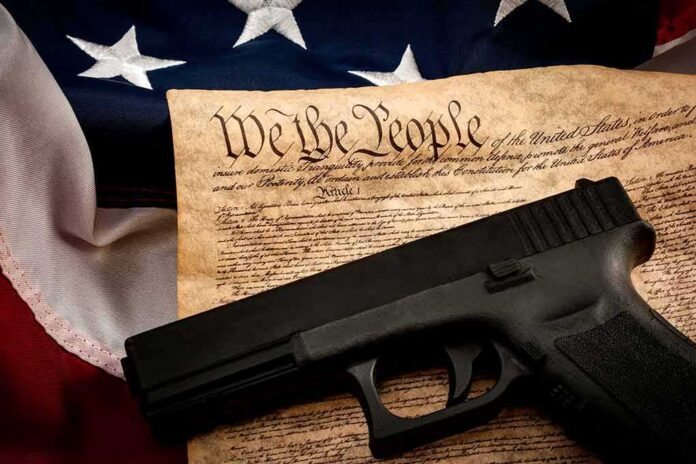
Virginia’s highest court just ruled that a nonviolent ex-felon remains part of “the people” protected by the Second Amendment.
Story Highlights
- Virginia Supreme Court reversed a felon-in-possession conviction and entered final judgment for the defendant.
- The court said a felony label does not erase Second Amendment rights for “the people” after sentence completion.
- Judges applied the Supreme Court’s history-and-tradition test, not a blanket ban.
- The ruling is “as applied,” leaving open cases involving violence or current danger.
Virginia’s Ruling Restores Rights After Sentence Completion
The Supreme Court of Virginia held that the state’s felon gun ban was unconstitutional as applied to Derek Wade Ginevan and ordered his conviction vacated with final judgment in his favor. The court said Virginia failed to prove a tradition that allows a permanent, one-size-fits-all disarmament of someone who already served his time. The court emphasized that people with felony records do not fall outside “the people” named in the Second Amendment. That language anchors the ruling’s core logic.
Judges weighed the case under the United States Supreme Court’s history-and-tradition method used in recent gun rights cases. The Virginia court found the Commonwealth could not show that a lasting ban for someone who completed punishment fits that tradition. The decision focused on the match between history and modern law, not sympathy for the defendant. The ruling also noted it was limited to the facts of this defendant’s record and conduct, which avoids declaring the entire statute invalid in every scenario.
Key Facts: The Case, The Conduct, The Limits
The case arose after Ginevan admitted he possessed a shotgun during a domestic-dispute response. Reports identify his prior crimes as drug offenses and larceny. Prosecutors charged him under Virginia Code section 18.2-308.2, which permanently bars felons from having guns. The Supreme Court did not excuse the incident. Instead, it held that the state did not carry its burden to justify a lifetime ban under the governing constitutional test. The court reversed and ended the case for him.
The court’s opinion is an as-applied ruling. That means it turns on these facts and does not answer every future case. The decision does not declare that all felons are free to carry. It leaves open how the law applies to people with violent records, repeat offenders, and those under protective orders or who present a present, credible threat. Those lines will be drawn in later cases or through tailored legislation consistent with history.
How The Commonwealth Framed Its Case—and Why It Fell Short
The Commonwealth argued that harsh founding-era punishments for felonies, including death and estate forfeiture, support a lesser modern power to disarm felons forever. It also pointed to historic rules that disarmed people who posed a threat of violence. Lower-court materials reflect that frame and cite the Supreme Court’s note about “longstanding prohibitions” on felons possessing firearms. The state’s position won earlier rounds, but it did not persuade the Virginia Supreme Court here.
Virginia appellate materials also describe a split view: some courts endorse bans for violent or dangerous felons as fitting tradition. The Watkins decision, for example, tied disarmament analogues to people who pose a threat of violence. The Supreme Court of Virginia, however, required proof connecting this defendant, after sentence completion, to a historical rule that allows permanent disarmament. On this record, the state’s showing did not meet that burden under the modern test.
Why It Matters To Law-Abiding Conservatives
This ruling defends the idea that rights belong to the people, not to a class favored by bureaucrats. When someone serves their sentence, the state should not hold their rights hostage forever. The United States Supreme Court confirmed that the government may disarm those who present a credible threat. But it must show that threat, not rely on a lifetime label. Virginia’s high court followed that path and demanded proof grounded in our nation’s traditions.
The decision pushes back on a broad, endless disability that sweeps in nonviolent conduct and past mistakes with no current danger. It invites targeted measures that address real threats while respecting the Constitution. It also reminds lawmakers that easy, blanket bans are not the same as safety. Careful, narrow tools can protect families and communities without turning the Second Amendment into a privilege for the few. That balance reflects common sense, not ideology.
What Comes Next In Virginia And Beyond
Expect new cases to test where the line falls for violent offenses, repeat crimes, and active restraining orders. Prosecutors will likely press threat-based arguments, and courts will ask for clear historical support. Lawmakers may consider rights-restoration processes that move faster and focus on risk. Nationally, lower courts continue to sort out how history guides the federal felon ban for some nonviolent offenders. That debate remains active and far from settled.
Sources:
reason.com, vacourts.gov, dcjs.virginia.gov, law.justia.com, supremecourt.gov