

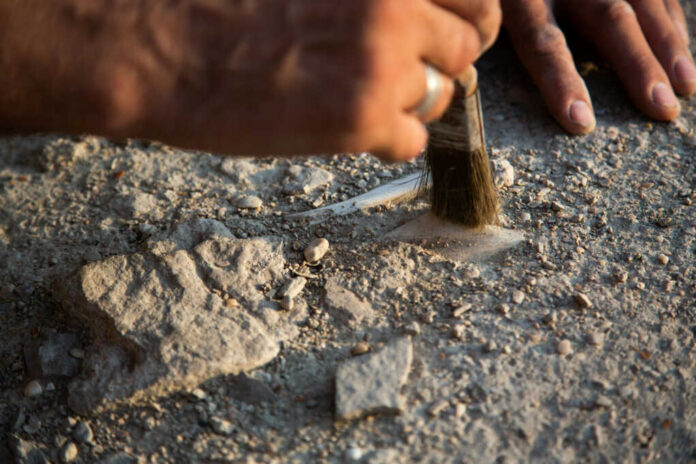
A battered duck-billed dinosaur skull with a broken Tyrannosaurus tooth in its face has given scientists one of the clearest snapshots ever of a real T. rex attack.
Story Snapshot
- A fossil skull of an Edmontosaurus shows a T. rex tooth driven straight through its snout, capturing a face-to-face attack.
- The embedded tooth comes from an adult Tyrannosaurus, and the bite pattern matches active predation, not simple scavenging.
- This new fossil joins other bite-mark evidence that has steadily crushed the old “T. rex was just a scavenger” myth.
- Scientists still note limits: one skull cannot prove every hunt was lethal, but it fits a growing hunter-and-sometimes-scavenger picture.
A skull that froze a T. rex strike in time
At Montana State University’s Museum of the Rockies, researchers studied a semi-complete adult Edmontosaurus skull known as MOR 1627 from the Hell Creek Formation in Montana. The bone of the nose, called the nasal, holds the broken crown of a large meat-eater’s tooth driven all the way into the dinosaur’s nasal cavity. This was not a scratch or a glancing blow. The tip punched through the top of the snout, showing a powerful, direct hit to the face from a massive predator.
The study’s authors compared the shape, size, and serrations of that embedded tooth with every known carnivorous dinosaur from the same rock layers. The match was clear: it is a middle–posterior tooth from an adult Tyrannosaurus, with details that line up with known T. rex skulls. The angle and curve of the tooth show the bite came from the front, as if the Edmontosaurus and T. rex were facing each other when the predator lunged and clamped down on the snout in a frontal attack.
Why this looks like a hunt, not just a carcass snack
Scientists looked at more than just the single tooth. They mapped tooth marks across the skull and studied how the bones were still joined together. The skull remains well articulated, which means the bones stayed in life position instead of being scattered, which would be more likely if the animal had long been dead. The direction of the main bite, the extra tooth marks, and that intact skull together point toward a live attack, not a gentle nibble on a long-dead body.
The paper is careful and scientific. It says scavenging cannot be totally ruled out but argues predation is the more likely answer for this fossil. The single, forceful bite to a bony snout matches the kind of risky, high-energy strike seen when a predator tries to bring down living prey, not the slower, pick-and-choose feeding seen on carcasses. For readers used to hearing soft-pedaled “maybe it was just a scavenger,” this is straight fossil evidence of aggressive hunting behavior.
Fitting into the long fight over T. rex’s reputation
For decades, some experts and media voices sold the idea that Tyrannosaurus rex might have lived mostly off dead meat, turning the “tyrant lizard king” into a sort of overgrown vulture. That picture has taken hit after hit as new fossils came to light. One famous earlier find was a T. rex tooth crown stuck in the tail vertebrae of another Edmontosaurus, wrapped in healed bone growth where the prey survived a tail bite. That fossil proved T. rex attacked live dinosaurs that sometimes got away.
Other studies and museum work have added more bite-mark evidence on large herbivores plus staggering bite force numbers for adult T. rex. An animal with a jaw strong enough to crush bone and teeth built to puncture, pull, and tear makes more sense as a hunter that also scavenged when it could. This new face-bite skull does not stand alone; it plugs into a growing set of finds that show T. rex was not timid or lazy. It chased, struck, and sometimes missed, just like modern big predators.
What this fossil can prove—and what it cannot
The MOR 1627 skull gives rare, close-up evidence of a violent meeting between a duck-billed dinosaur and an adult T. rex, but scientists still show discipline about what they claim. They do not say this single bite killed the Edmontosaurus for sure. Instead, they note that healing around the tooth is not obvious and suggest the tooth broke off when the predator bit near the time of death. That detail hints at a lethal or very serious attack, but they stop short of calling it “proven” death.
Rare fossil evidence shows a face-to-face T. rex bite: an Edmontosaurus skull with a embedded Tyrannosaurus tooth reveals how ferocious and precise Rex predation was. A dramatic window into ancient hunting behavior. #Paleontology #T rex #Fossils https://t.co/IgMYGrOlaQ
— Devin Womack (@devinwo) July 14, 2026
The study also reminds readers that one fossil is just one data point. It cannot, by itself, settle every argument about how often T. rex hunted versus scavenged. But when you stack this skull beside the healed-tail fossil, other bite-mark cases, and T. rex’s weapon-like anatomy, the pattern is hard to ignore. The “pure scavenger” idea now looks more like an outdated talking point than a real scientific view. The evidence supports an apex predator that grabbed any advantage it could—whether running down live prey or stealing a carcass.
Sources:
pmc.ncbi.nlm.nih.gov, pnas.org, scmp.com, pubmed.ncbi.nlm.nih.gov, nationalgeographic.com, dailymail.co.uk